Wet vs Dry Magnetic Particle Testing: Which Method Should You Use?
Wet and dry magnetic particle testing (MPI) are both used to detect surface and near-surface defects in ferromagnetic materials. The key difference is sensitivity versus practicality: wet MPI offers higher detection sensitivity for fine cracks, while dry MPI is better suited for rough surfaces, field conditions, and large-scale inspections.
The right choice depends on defect size, inspection environment, and component criticality.
Wet vs Dry MPI: Quick Comparison
| Feature | Wet MPI | Dry MPI |
|---|---|---|
| Sensitivity | Highest | Moderate |
| Best for | Fine cracks | Rough surfaces |
| Surface condition | Smooth | Rough/hot |
| Environment | Controlled shop | Field |
| Portability | Lower | Higher |
| Cost | Higher | Lower |
The Science Behind Magnetic Particle Testing
Magnetic particle testing (MPT or MPI) works by magnetizing ferromagnetic materials. Surface or near-surface defects disrupt the magnetic field, creating flux leakage. Magnetic particles accumulate at these leakage points, forming visible indications.
Detection strength depends on defect orientation, particle mobility, and field direction.
Principles of Wet Magnetic Particle Testing
Wet Magnetic Particle Testing uses magnetic particles suspended in a liquid carrier (water or oil) applied to a magnetized surface. The liquid improves particle mobility, allowing them to quickly migrate to flux leakage sites and form visible indications.
It typically uses fine or fluorescent particles under UV light, making it highly sensitive for detecting tight or fine surface cracks. Wet MPI is best suited for controlled environments and high-sensitivity inspections.
Principles of Dry Magnetic Particle Testing
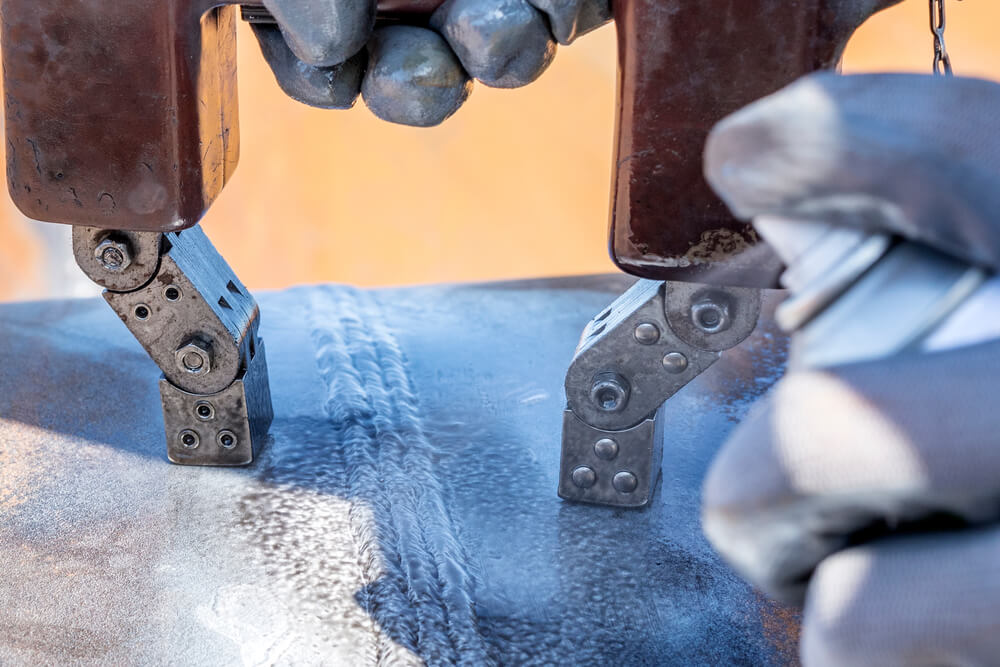
Dry Magnetic Particle Testing applies magnetic powder directly to a magnetized surface using a bulb, spray, or gun. Particles gather at flux leakage areas to reveal surface and near-surface defects.
It uses larger particles than wet MPI, making it more effective on rough surfaces, hot parts, and field conditions. While less sensitive to very fine cracks, it is widely used for general inspection and maintenance work.
Defect Detection Capabilities
Dry MPI is most effective for larger surface-breaking defects such as cracks and seams, while wet MPI is better suited for detecting fine or tight discontinuities. Surface condition plays a major role, as rough or contaminated surfaces can reduce detection reliability.
When Should You Use Dry vs Wet Magnetic Particle Testing?
| Scenario | Best Method |
|---|---|
| Rough welds | Dry |
| Fine fatigue cracks | Wet |
| Aerospace components | Wet fluorescent |
| Outdoor field inspections | Dry |
| Hot surfaces | Dry |
| Production line testing | Wet |
Comparative Sensitivity and Detection Capabilities
We’ll now examine the comparative sensitivity of magnetic particle testing by evaluating detection thresholds and defect orientation effects across different inspection scenarios.
Detection Threshold Comparison
- Wet MPI: detects ~30 micron defects in ideal conditions
- Dry MPI: typically detects 100+ micron defects
- Wet fluorescent methods provide the highest sensitivity
- Dry methods are better suited for larger discontinuities
Defect Orientation Effects
Defect orientation relative to the magnetic field is one of the most critical factors in magnetic particle testing performance. Defects aligned perpendicular to the magnetic flux produce the strongest indications, while those parallel to the field may produce weak or no indication at all.
Wet MPI generally provides more consistent detection across varying orientations due to higher particle mobility in the liquid carrier, which helps particles migrate into weaker or slightly misaligned leakage fields. Fluorescent wet techniques further improve the visibility of these indications.
Dry MPI is more sensitive to orientation effects and may miss defects that are not favorably aligned with the magnetic field. To mitigate this, multi-directional magnetization is commonly used, applying the field from at least two directions to improve detection reliability in complex geometries or when defect orientation is unknown.
Surface vs. Subsurface Detection
Magnetic particle testing is primarily a surface and near-surface inspection method. It is highly effective at detecting cracks and discontinuities that break the surface, but its ability to identify subsurface defects decreases rapidly with depth.
In general, MPT can reliably detect flaws only a few millimeters below the surface, depending on part geometry, material properties, and magnetization strength. Wet methods may offer slightly improved sensitivity to deeper discontinuities due to better particle mobility, but neither wet nor dry MPI is suitable for deep subsurface evaluation.
For defects located beyond near-surface regions, volumetric methods such as ultrasonic testing (UT) or radiographic testing (RT) are required to ensure full inspection coverage.
Environmental Considerations and Constraints
Magnetic particle testing performance is affected by environmental conditions, particularly temperature, humidity, and ventilation.
Wet MPI is more sensitive to temperature extremes, which can impact particle suspension stability and reduce inspection reliability. Oil-based carriers also require controlled handling and proper disposal to meet environmental regulations, while water-based carriers reduce environmental impact but may introduce corrosion risks on certain materials.
Dry MPI is less affected by temperature but can be impacted by high humidity, which may cause particle clumping and uneven application. Dust generation also requires adequate ventilation and respiratory protection to ensure technician safety.
Both methods must be selected with site conditions in mind, including environmental controls, waste management requirements, and regulatory compliance standards.
At WH Labs, we ensure that environmental testing factors are properly evaluated according to industry standards for consistent and reliable MPT results.
Equipment Requirements and Setup
Dry Magnetic Particle Testing Equipment
- Magnetic field generation tools (yokes or prods)
- Powder application tools (bulb, spray, or powder gun)
- Dry magnetic particle powders (standard or fluorescent)
- UV-A lighting (for fluorescent inspections)
- Portable power source (for field use)
- Demagnetization equipment
- Field strength verification tools
Wet Magnetic Particle Testing Equipment
- Magnetic field generation equipment (yokes, coils, or fixed systems)
- Particle suspension tank or circulation system
- Wet magnetic particle suspensions (water- or oil-based)
- Spray or flooding application system
- UV-A black light inspection station (for fluorescent MPI)
- Agitation and concentration control system
- Demagnetization equipment
- Field strength and calibration instruments
Common Equipment (Both Methods)
- Calibration standards and reference blocks
- Inspection lighting systems
- Cleaning and surface preparation tools
- Safety equipment (PPE, ventilation where required)
- Compliance tools for standards (ASTM, ASME, ISO)
Industry-Specific Applications and Standards
While various industries utilize magnetic particle testing, each sector has developed specialized standards and procedures to address unique inspection challenges.
We’ve compiled key industry standards that govern MPT implementation across different fields:
- Aerospace (AS5282) – Requires higher sensitivity levels and often mandates fluorescent particles for critical components like turbine disks and landing gear
- Automotive (ASTM E1444) – Focuses on high-volume testing of drivetrain components with standardized acceptance criteria for various defect types
- Oil and Gas (ASME BPVC) – Emphasizes wet method testing for pipeline welds and pressure vessels operating in harsh environments
- Military (MIL-STD-1949) – Specifies rigorous documentation requirements and personnel qualification standards, often requiring both wet and dry methods
We’ll help you navigate these standards to guarantee your inspection protocols maintain compliance while maximizing defect detection. Similar to magnetic particle testing, ultrasonic testing techniques can be tailored for specific industry applications to detect internal flaws without causing damage to materials.
Cost Analysis and Operational Efficiency
Implementing magnetic particle testing effectively requires balancing initial equipment investments against long-term operational benefits. Wet method systems typically demand higher upfront costs ($15,000-$40,000) for specialized equipment, recirculation systems, and particle baths. However, they offer faster inspection rates and superior detection sensitivity, particularly for automated production environments.
Dry systems, costing $3,000-$10,000 initially, present a more economical entry point for facilities with limited testing needs. We’ve found they require less maintenance and consumable expenses but may incur higher labor costs due to slower inspection rates.
When calculating the total cost of ownership, we must consider facility infrastructure requirements, technician training, waste disposal protocols, and regulatory compliance. The ideal choice ultimately depends on testing volume, defect detection requirements, and available facility resources. Both testing methods should adhere to ASTM standards to ensure consistent and reliable results across different testing laboratories.
Best Practices for Method Selection
Selecting the appropriate magnetic particle testing methodology requires a thorough assessment of several critical parameters.
We need to evaluate the inspection environment, defect characteristics, part geometry, and operational constraints to optimize detection reliability.
When determining which method will yield superior results, we’ve found these factors most critical:
- Material composition and permeability values that affect magnetic field distribution
- Surface condition, including roughness, coatings, and potential contaminants
- Defect orientation relative to the induced magnetic field path
- Production throughput requirements and facility limitations
We recommend conducting comparative tests on representative samples when uncertainty exists.
This practical approach prevents potential detection misses and guarantees we’re maximizing inspection effectiveness.
Remember that proper method selection ultimately serves as the foundation for dependable quality assurance protocols.
Our Non-Destructive Testing specialists can provide expert guidance on selecting the best method for your specific inspection needs.
Frequently Asked Questions
How Long Does Technician Certification for Magnetic Particle Testing Take?
We typically complete MT certification in 40-80 hours of training plus practical experience. Requirements include classroom instruction, hands-on practice, and passing examinations according to industry standards like SNT-TC-1A.
Can Magnetic Particle Testing Be Performed on Non-Ferromagnetic Materials?
No, we can’t perform magnetic particle testing on non-ferromagnetic materials. This NDT method relies on materials that respond to magnetic fields, like iron, nickel, and cobalt alloys.
What Safety Precautions Are Required When Handling Magnetic Particle Testing Materials?
We’ll need proper PPE, including gloves and eyewear, when handling magnetic particles. We must follow SDS guidelines, guarantee adequate ventilation, and avoid inhalation of dry particles or aerosols.
How Often Should Magnetic Particle Testing Equipment Be Calibrated?
We recommend calibrating MPT equipment annually at a minimum, with additional verification checks before each use. ASTM E1444 and ASNT guidelines specify standards our industry follows for proper instrument performance.
Can Magnetic Particle Testing Detect Subsurface Defects in Welded Joints?
We can detect shallow subsurface defects in welded joints using magnetic particle testing, but its effectiveness diminishes rapidly with depth. For deeper defects, consider ultrasonic or radiographic methods instead.
Takeaway
We’ve established that method selection hinges on defect characteristics, equipment availability, and inspection criticality. Wet testing delivers superior sensitivity for fine discontinuities in critical components, while dry testing offers cost-efficiency for general inspections of large surfaces. Our implementation decisions must balance sensitivity requirements against operational constraints, always adhering to industry-specific standards that govern magnetic particle testing procedures.
References:
https://magnaflux.com/Magnaflux/Products/Magnetic-Particle-Inspection.htm