Weld Overlay vs. Cladding: A Guide for Surface Protection
In heavy industrial manufacturing, particularly within the oil and gas, petrochemical, and power generation sectors, components are frequently exposed to extreme pressures, temperatures, and highly corrosive media. To balance cost-efficiency with structural integrity, engineers rarely manufacture large components entirely out of expensive Corrosion-Resistant Alloys (CRA). Instead, they utilize a carbon or low-alloy steel base for strength and apply a protective layer of high-performance material to the surface.
This practice is generally referred to as Cladding, while Weld Overlay (WOL) is a specific method used to achieve it. Understanding the technical nuances between these processes is critical for selecting the right manufacturing path for a specific application.
Defining the Terms: Category vs. Process
To understand the differences between cladding and overlay processes, one must first establish the hierarchy of the terminology.
- Cladding is a broad category. It refers to any process where a thin layer of one metal is bonded to the surface of another base metal. The goal is to provide a protective barrier or coating without the high cost of making the entire part from the expensive alloy.
- Weld Overlay (also known as “hardfacing” or “weld cladding”) is a specific subset of cladding. It is the process of depositing the protective layer by fusion welding. (Learn more about hardfacing vs cladding differences)
While all weld overlays are a form of cladding, not all cladding is done via welding.
What is Cladding? (Non-Welded Methods)
Traditional cladding often involves mechanical or high-pressure bonding techniques. These are typically performed at the mill level during the production of plates or pipes.
Explosion Bonding
This process uses the controlled energy of an explosion to force two metal plates together at massive pressure. The impact creates a “wave” interface between these dissimilar metals, resulting in a high-strength mechanical and metallurgical bond without the use of heat that could distort the grain structure.
Roll Bonding
In roll bonding, the base material and the cladding alloy are passed through heavy rollers under pressure and temperature. The two materials are physically squeezed until they bond into a single composite plate.
Mechanical Lining
Often used in pipeline applications, a “lined pipe” involves sliding a CRA sleeve inside a carbon steel pipe. The inner sleeve is expanded mechanically or hydraulically against the outer pipe. Unlike overlay welding or roll bonding, there is no metallurgical fusion here; it is an interference fit.
At WH Labs, our experienced team can clad with a variety of materials such as duplex stainless steel, Inconel, nickel alloys, and other materials from the nickel and steel families.
What is Weld Overlay?
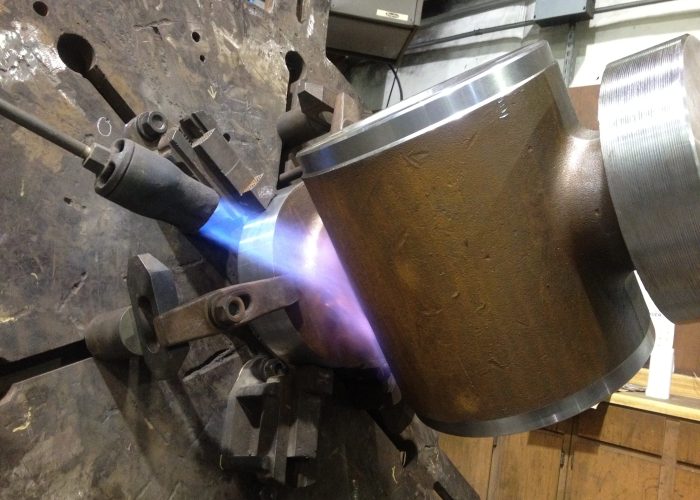
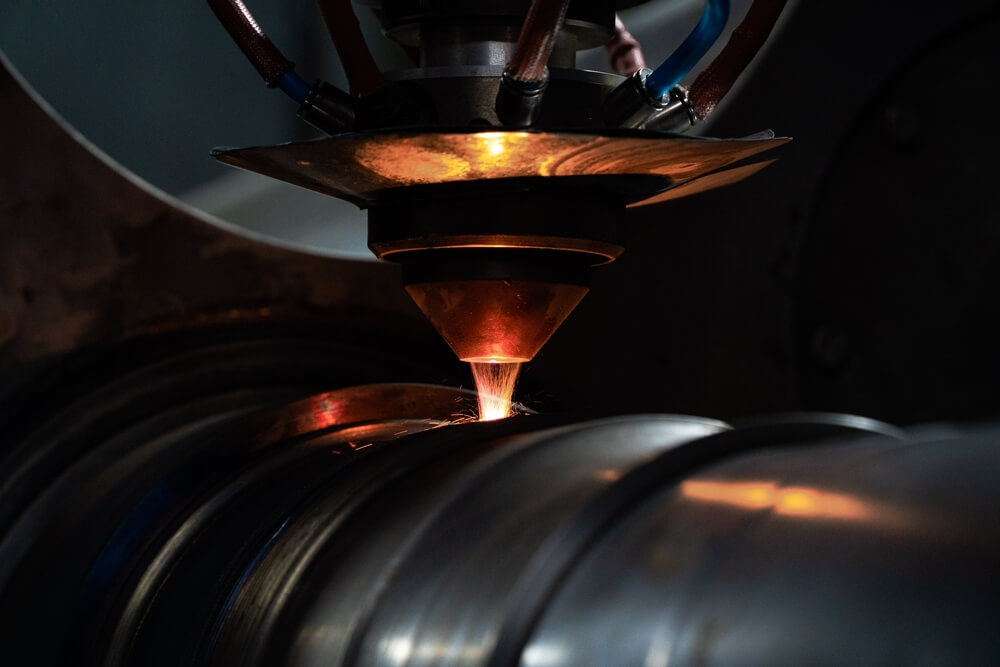
Weld overlay is the process of applying one or more layers of a metal onto a base metal surface via an electric arc or other heat sources. This creates a metallurgical bond, meaning the two materials are fused at the atomic level.
Key Weld Overlay Processes
The choice of welding process depends on the geometry of the part and the required deposition rate:
- Gas Tungsten Arc Welding (GTAW) / Hot Wire TIG: Highly preferred for its precision and low “dilution” (the mixing of base metal into the overlay). Hot wire TIG (tungsten inert gas) increases deposition rates, making it an industry standard for complex oil and gas components.
- GMAW (MIG – Metal Inert Gas Welding): Offers higher speeds than TIG but can be more prone to weld defects if not strictly controlled.
- Shielded Metal Arc Welding (SMAW): Often referred to as “Stick” welding. While slower than automated processes, it is highly versatile and portable. It is the primary choice for field repairs, maintenance, and cladding in tight spaces where automated equipment cannot be positioned.
- Submerged Arc Welding (SAW): Uses a consumable electrode and a bed of granular flux. It is excellent for large, flat surfaces or the external diameters of large pipes due to its extremely high deposition rates.
- Plasma Transferred Arc (PTA) Welding: A high-energy process that provides a very dense and high-quality layer, often used for hardfacing.
Key Differences between Cladding and Weld Overlay
| Feature | Cladding (Non-Welded/Mill-Bonded) | Weld Overlay (Fusion-Based) |
| Bonding Mechanism | Mechanical (Interference) or Pressure/Heat (Explosion/Roll) | Metallurgical Fusion (Atomic-level bond via melting) |
| Ideal Geometry | Simple: Flat plates, straight pipes, and large vessels | Complex: Valves, flanges, bends, and internal bores |
| Material Dilution | Near Zero: The alloy chemistry remains pure throughout the layer | Variable: Base metal mixes into the alloy (requires multiple layers for purity) |
| Thermal Impact | Minimal to none (for explosion/mechanical methods) | High: Creates a Heat Affected Zone (HAZ) in the base metal |
| Heat Treatment | Usually not required for the bond itself | Required: Often needs Post-Weld Heat Treatment (PWHT) to relieve stress |
| Application Type | New manufacturing of primary structural materials | New manufacture + Repair/Refurbishment of worn parts |
| Flexibility | Limited to available mill-clad plate sizes | Highly flexible; can be applied in-shop or in the field (SMAW) |
| Bond Integrity | High (Roll/Explosion) to Moderate (Lining) | Highest: Cannot delaminate due to fusion bond |
Geometry and Complexity
The most significant practical difference lies in the shape of the part.
- Cladding (Roll/Explosion): Is generally limited to simple, flat geometries like plates or long, straight pipes.
- Weld Overlay: Is the only viable option for complex shapes. Components like valves, flanges, “T” junctions, and subsea manifolds require the flexibility of a welding torch to reach internal diameters and irregular contours.
The Dilution Factor
A critical technical challenge in weld overlay is dilution. When you weld an alloy (like Inconel 625) onto carbon steel, a portion of the carbon steel melts and mixes into the alloy layer. If the dilution is too high, the corrosion resistance of the overlay is compromised.
Engineers often require a second or third layer of weld overlay to ensure the surface chemistry meets the 100% alloy specification. In contrast, roll-bonded cladding typically maintains the pure chemistry of the alloy sheet throughout its thickness.
Heat Affected Zone (HAZ)
Weld overlay introduces significant heat into the base metal. This creates a Heat Affected Zone (HAZ) where the mechanical properties (like hardness or toughness) of the base steel may change. This often necessitates Post-Weld Heat Treatment (PWHT) to stress-relieve the part. Mechanical cladding methods like explosion bonding or lining avoid this thermal stress.
Material Selection: Base Metals and CRAs
The objective of both processes is to combine the mechanical strength of the Base Metal with the chemical resistance of the Corrosion-Resistant Alloy (CRA).
- Common Base Metals: ASTM A36, A516 Grade 70 (Pressure Vessel Steel), and 4130/4140 low-alloy steels.
- Common Overlays/Clads: Stainless Steels (304, 316, 317): General corrosion resistance.
- Inconel 625: High resistance to pitting and crevice corrosion in seawater and “sour” (H2S) gas environments.
- Monel & Hastelloy: Used in highly acidic or specialized chemical environments.
- Stellite: Used specifically for “hardfacing” where wear and abrasion resistance are more important than corrosion resistance.
Industry Applications
Oil and Gas Industry (Subsea and Topside)
The oil and gas industry is the largest consumer of overlay welding technology. Subsea trees, manifolds, and wellheads are almost always carbon steel with an Inconel 625 overlay. These parts must survive 20+ years on the ocean floor, and the complexity of these parts makes roll cladding impossible.
Pressure Vessels and Nuclear
In nuclear reactors and chemical reactors, the internal walls are often clad with stainless steel. For very large vessels, manufacturers may use clad plates (roll-bonded) for the walls but use weld overlay for the nozzles and entry points where pipes connect to the vessel.
Repair and Maintenance
Weld overlay is uniquely used for “building up” worn parts. If a shaft or a valve seat has been eroded, weld overlay can deposit new material to restore the original dimensions, which is something mechanical cladding cannot achieve.
Selecting the Right Method
Choosing between these methods involves a balance of three factors:
- Component Shape: If the part is a flat plate, roll cladding is faster and cheaper. If it is a valve or flange, a weld overlay is mandatory.
- Bond Integrity: In high-pressure environments where the layer must never delaminate, the metallurgical bond of an overlay is generally superior to the mechanical lining.
- Lead Time and Cost: Clad plates are often long-lead items from specialized mills. Weld overlay can often be performed in-house by specialized fabrication shops, offering more control over the production schedule and a more economical solution.
Whether you need cladding or custom overlay solutions, our team will work with you to meet your specific requirements and challenges.
Conclusion
In summary, while cladding describes the goal of protecting a metal surface with an alloy, weld overlay is the specific engineering solution used when the part is complex, requires a fusion bond, or is being repaired.
By understanding the role of dilution, the impact of the Heat Affected Zone, and the limitations of different bonding methods, engineers can ensure that their equipment survives the harshest environments while remaining cost-effective. Whether utilizing the brute force of explosion bonding or the precision of automated TIG weld overlay, the result is a high-performance composite material capable of withstanding the rigors of modern industry.