Houston Liquid Penetrant Testing (PT) Services
WH Labs performs liquid penetrant testing (PT) in Houston to find surface-breaking defects in welds, castings, and forgings on non-porous materials such as metals, plastics, and ceramics. The method applies a penetrant that seeps into fine cracks through capillary action, then draws it back out with a developer to make the defect visible under fluorescent or visible light. WH Labs’ ASNT Level II and III certified technicians perform PT in-house, with results typically available the same day.
How Liquid Penetrant Testing Works
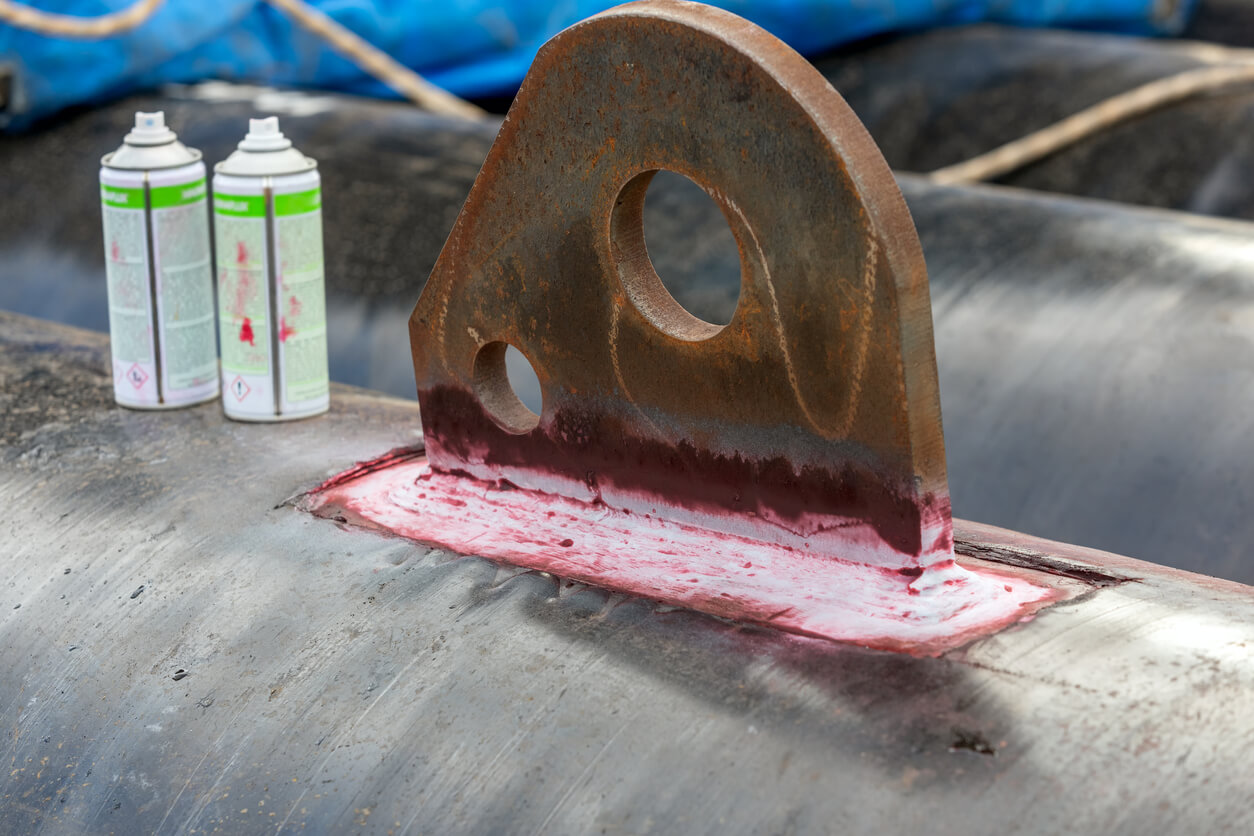
Liquid penetrant testing works by applying a penetrant to a clean, dry surface, allowing it to seep into surface-breaking discontinuities through capillary action, then removing the excess and applying a developer that draws the trapped penetrant back out to form a visible indication. WH Labs follows this process for every PT inspection.
- Surface preparation to remove dirt, grease, paint, and rust that would block the penetrant from reaching a defect
- Penetrant application, using fluorescent or visible dye depending on the part and required sensitivity
- Dwell time to allow the penetrant to seep into any surface-breaking discontinuities
- Removal of excess penetrant and application of a developer, which draws the trapped penetrant back out to reveal the defect
- Inspection under fluorescent (UV-A) or visible light, depending on the penetrant type used
- Documentation of findings for the project’s inspection record
PT is not suitable for porous materials, since the penetrant can seep into the material itself rather than staying at a surface defect. It’s often paired with magnetic particle testing when a project involves both ferromagnetic and non-ferromagnetic components.
Why Choose Us for Liquid Penetrant Testing in Houston, TX
Accredited and Certified
WH Labs holds ISO/IEC 17025:2017 accreditation and Nadcap merit status for penetrant testing. PT inspections comply with ASTM E1417 and ASME Boiler and Pressure Vessel Code, Section V, Article 6, and are performed by Level II and Level III technicians holding active SNT-TC-1A certification.
Advanced Equipment
WH Labs, Houston’s premier NDT facility, uses Type I fluorescent and Type II visible dye penetrant systems, including water-washable and post-emulsifiable penetrants meeting AMS 2644 requirements, automated processing lines, LED UV-A illumination, and digital imaging support consistent, well-documented results.
Fast Turnaround
A standard liquid penetrant inspection, from surface preparation through final inspection, takes about 45 to 60 minutes per ASTM E1417 protocol.
Industries We Serve
WH Labs performs liquid penetrant testing for industries where surface-breaking defects carry the highest safety and cost consequences:
- Oil & Gas — pipeline components, pressure vessels, and wellhead equipment
- Petrochemical industry — pipeline welds and other welding surface defects, pressure vessel seams, and valve bodies
- Aerospace — turbine parts, landing gear, and critical airframe structures
- Power Generation — nuclear, fossil fuel, and renewable energy facilities
- Manufacturing — precision-machined components, castings, and fabricated assemblies
Liquid penetrant testing is one part of WH Labs’ broader non-destructive testing services, which also include magnetic particle testing for ferromagnetic materials and ultrasonic testing for subsurface flaws.
Recent Results
Recent WH Labs PT inspections have caught defects before they became larger problems, including:
- Microscopic stress cracks in aerospace turbine blades, identified before they could compromise flight safety
- Weld discontinuities in a petrochemical facility’s pressure vessels, found during a routine inspection
- Reduced defect escape rates on an automotive parts production line after implementing automated PT testing
- Surgical instrument integrity validation supporting a medical device manufacturer’s regulatory compliance
Frequently Asked Questions
How Long Does a Typical Liquid Penetrant Testing Procedure Take to Complete?
A standard inspection takes about 45 to 60 minutes, including surface preparation, penetrant application, dwell time, developer application, and final inspection.
Can liquid penetrant testing be performed in wet or humid conditions?
No. Moisture interferes with the penetrant’s surface tension and capillary action, so a dry surface is required for reliable results.
What materials can be tested with liquid penetrant testing?
PT works on non-porous materials, including metals, plastics, and ceramics. It isn’t effective on porous materials, since the penetrant can seep into the material itself rather than pooling at a surface defect.
How soon after welding can penetrant testing be performed?
WH Labs recommends waiting until the weld cools below 125°F (52°C). Testing on a hot surface can reduce penetrant sensitivity and cause premature evaporation.
What does liquid penetrant testing cost?
Pricing typically ranges from $50 to $200 per component depending on size, complexity, and preparation requirements. Contact WH Labs for a project-specific quote.
What is the minimum size of defect that PT testing can detect?
We can typically detect surface defects as small as 0.5 microns wide and 10 microns deep through PT testing, though ideal conditions and proper technique are essential for this sensitivity level.
Schedule Liquid Penetrant Testing in Houston
Liquid penetrant testing catches the surface-breaking flaws that can compromise a weld, casting, or forging before it’s put into service. WH Labs performs PT in-house across Houston, backed by ASNT-certified technicians and ISO/IEC 17025-accredited quality systems.
Get a Free Quote to schedule liquid penetrant testing, or ask about pairing it with magnetic particle or ultrasonic testing for full inspection coverage.