Houston, Texas: An Overview of the Region’s Industrial Economy
Houston’s industrial economy is built around a few things that work unusually well together: a deep-water shipping channel, direct access to the Gulf of Mexico, a dense pipeline network, large-scale refining and chemical operations, major transportation links, and a broad manufacturing base.
That footprint is not confined to Houston’s city limits. Much of it runs east and southeast through Pasadena, Deer Park, La Porte, Baytown, Channelview, and Galena Park, with additional industrial centers around Texas City and Mont Belvieu. At the center of it all is the Houston Ship Channel, which connects the region to Galveston Bay and the Gulf and provides the marine link for a corridor built around moving energy products, chemicals, raw materials, equipment, and manufactured goods. The result is a tightly connected industrial system rather than a collection of unrelated plants: refineries, chemical plants, terminals, pipelines, manufacturers, railroads, and industrial service providers all depend on the same underlying network.
Houston’s Industrial Economy at a Glance
| Statistic | Figure | Year | Source |
|---|---|---|---|
| Metro population (10-county region) | 7.9 million | 2025 | Houston.org |
| Manufacturing establishments | 7,251 | 2025 Q4 | GHP, Houston Facts 2026 |
| Manufacturing employees | 236,659 | 2025 Q4 | GHP, Houston Facts 2026 |
| Value of manufactured goods | $126.9 billion (16.7% of regional GDP) | 2024 | U.S. Bureau of Economic Analysis |
| Chemical plants | 706 | 2025 | GHP, Houston Facts 2026 |
| Chemical industry employees | 42,337 (17.9% of manufacturing workforce) | 2025 | GHP, Houston Facts 2026 |
| Houston’s share of U.S. base petrochemical capacity | 41.1% | 2025/26 | CAS Registry via IHS Markit, June 2026 |
| Houston-metro crude refining capacity | 2.6 million barrels/calendar day (14.0% of U.S. capacity) | 2025 | U.S. EIA, Refinery Capacity Report |
| Refinery employees | 7,345 | 2025 | Texas Workforce Commission, QCEW |
| Port Houston public-terminal tonnage | 54,491,066 short tons (record) | 2025 | Port Houston |
| Port Houston total foreign trade | 213.2 million metric tons / $205.8 billion | 2025 | Houston Facts 2026, citing U.S. Census Bureau |
| Port Houston container volume | 4,303,345 TEUs (record) | 2025 | Port Houston |
Port activity gives a real-time read on the region’s momentum. Through the first half of 2026, Houston Ship Channel regional trade by tonnage was running 16% ahead of the prior year, with exports up 22%; through July 2026, Port Houston had handled nearly 2.6 million TEUs, alongside 10,859 deep-draft vessel transits and 129,814 barge transits year-to-date (Port Houston, HSC Report).
Houston’s Industrial Geography
Houston and the Gulf Coast
Houston sits roughly 50 miles inland from the Gulf of Mexico, connected to it by Galveston Bay and the Houston Ship Channel. This inland-but-connected position is what allowed heavy industry to cluster here: deep-water access for tankers and bulk carriers, combined with proximity to Texas and Gulf of Mexico crude oil and natural gas production, pipeline networks, and a large inland labor and manufacturing base.
The Houston Ship Channel Corridor
Industrial development in the region follows the Ship Channel almost exactly. Refineries, chemical plants, storage terminals, fabrication yards, and port facilities sit shoulder to shoulder along its roughly 52-mile length, from the Turning Basin near downtown Houston out through Galveston Bay to the Gulf.
Major Industrial Areas Around Houston
| Area | Major Industrial Connections |
|---|---|
| Pasadena & Deer Park | Refining, petrochemical, chemical manufacturing, storage and industrial support |
| La Porte & Bayport | Petrochemical, manufacturing, port infrastructure; close to Galveston Bay and the Ship Channel |
| Baytown | Refining, petrochemical, manufacturing, strong marine and transportation connections |
| Channelview & Galena Park | Upper Ship Channel terminals, pipelines, storage and manufacturing |
| Texas City | Refining, chemical and maritime activity at the mouth of the Ship Channel |
| Mont Belvieu & East Harris County | Natural gas liquids processing, fractionation and storage feeding the wider petrochemical supply chain |
The Houston Ship Channel
The Role of the Houston Ship Channel
The Houston Ship Channel is the backbone of the region’s maritime-industrial system. It moves crude oil and refined products, raw petrochemical feedstocks, plastics, machinery, and manufactured goods between Houston-area facilities and world markets, and links directly to the refineries and chemical plants built along its banks.
Port Houston
Port Houston operates eight public facilities along the Ship Channel; the wider channel complex includes more than 200 private terminals, making the waterway much larger than the public port alone. That distinction matters because much of the region’s industrial activity happens at private terminals and industrial properties, not just the public port. Water transportation is especially useful for cargo that is heavy, bulky, or moved in large volumes, and Port Houston’s own facilities handle containers as well as steel, general cargo, project cargo, and bulk materials (Port Houston, Breakbulk & Project Cargo).
For industrial companies, the port’s significance is less about any single cargo number and more about connectivity: a shipment can arrive by vessel and move into Houston’s highway, rail, warehouse, terminal, or pipeline network, and the same network moves products back toward the port for export. That multimodal connection is a major reason industrial facilities keep clustering around the Ship Channel.
Major Port Facilities
Selected public facilities along the channel include the Barbours Cut and Bayport container terminals and the Turning Basin, the area’s largest breakbulk facility, alongside hundreds of private industrial and petrochemical docks.
Petroleum Refining in the Houston Region
Refining is one of the most visible parts of Houston’s industrial economy, but refinery statistics need a clear date and geographic definition. Greater Houston Partnership’s Houston Facts 2025 report states the Houston metro had 2.8 million barrels per calendar day of crude operating capacity in 2024, or 15.3% of U.S. capacity, with 8,138 refinery workers that same year. That figure should be read as a 2024 Houston-metro snapshot, not a current number: refinery operations change. For example, EIA data shows LyondellBasell ended refining at its 263,776-barrel-per-day Houston refinery in March 2025.
For a current, facility-level picture, the EIA’s annual Refinery Capacity Report is the better source. As of January 1, 2026, EIA listed ExxonMobil’s Baytown refinery at 564,500 barrels per calendar day and Marathon’s Galveston Bay refinery in Texas City at 631,000 barrels per calendar day (EIA, Refinery Capacity Report). Separately, the broader Gulf Coast refining district (from Corpus Christi through Beaumont-Port Arthur) holds more than half of total U.S. refining capacity, though that figure spans well beyond the Houston metro itself (U.S. EIA).
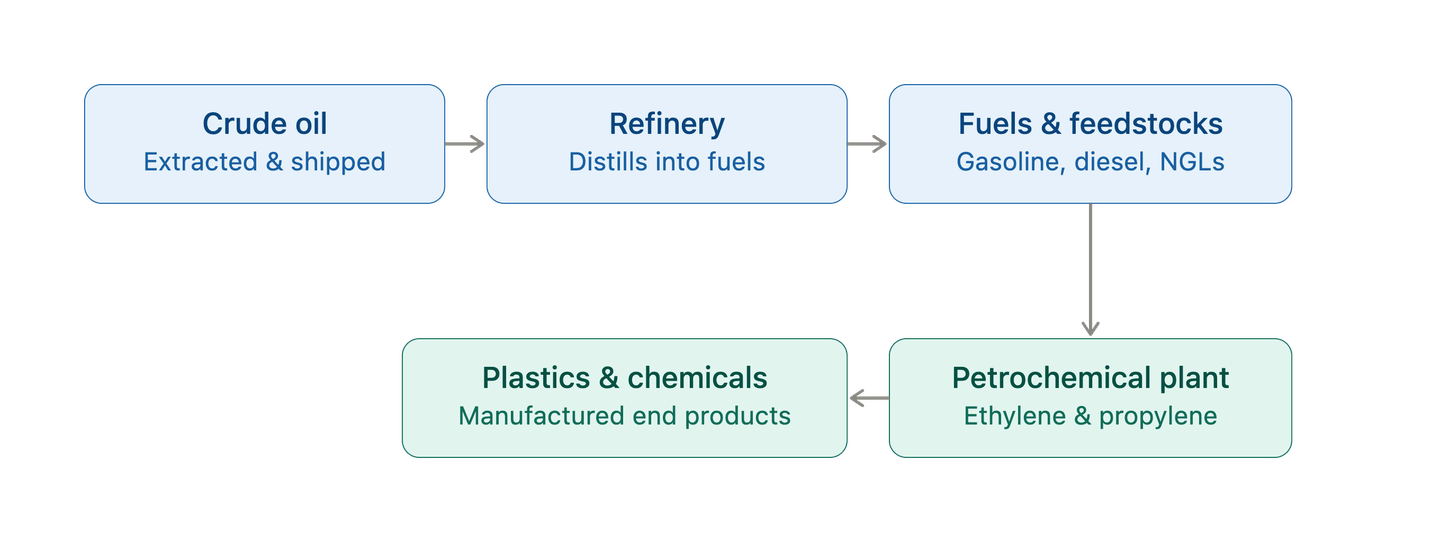
A simple diagram illustrates why so many facility types cluster together here: crude oil arrives, is distilled at a refinery into fuels and feedstocks, and those feedstocks flow into petrochemical plants that turn them into plastics, chemicals, and manufactured end products. Every stage of that chain, from piping and pressure vessels to tanks and structural steel, requires ongoing fabrication, welding, and inspection work to build, maintain, and periodically recertify.
Houston’s Petrochemical & Chemical Industry
The Houston Petrochemical Complex
Houston’s chemical industry grew alongside its refining and natural-gas infrastructure. Access to feedstocks, pipelines, storage, ports, and customers allows multiple stages of production to sit close together. Texas Workforce Commission counted 706 chemical plants and 42,337 chemical workers in 2025 and put the region’s share of U.S. base petrochemical manufacturing capacity at 41.1%.
| Feedstock | Houston MSA capacity (million metric tons/year) | Share of U.S. capacity |
|---|---|---|
| Ethylene | 18.6 | 41.7% |
| Propylene | 14.0 | 40.2% |
| Xylenes | 3.5 | 38.4% |
| Benzene | 2.5 | 40.5% |
| Toluene | 2.1 | 39.9% |
| Butadiene | 1.3 | 60.8% |
Source: GHP, Houston Facts 2026
These chemicals are not finished products on their own; they are feedstocks and intermediates used to make plastics, resins, synthetic materials, and other goods, which is why chemical production and manufacturing are so closely linked in Houston.
Why Petrochemical Facilities Cluster Around Houston
Petrochemical plants locate here because refineries, pipeline networks, storage terminals, deep-water port access, and feedstock supply are already in place; each new plant plugs into existing infrastructure rather than building it from scratch, reinforcing the cluster over time. New and expanding facilities each add another site that needs procedure-qualified welding, structural fabrication, and code-compliant weld testing before it can start up.
Major Petrochemical Areas
The petrochemical footprint extends well beyond Harris County, reaching Pasadena, Deer Park, La Porte, Baytown, Channelview, Texas City, and Mont Belvieu, a key hub for natural gas liquids fractionation and storage in Chambers and Liberty counties.
Houston’s Pipeline & Energy Infrastructure
An extensive underground pipeline network connects Houston-area refineries, petrochemical plants, storage terminals, and fractionation facilities to one another and to other Gulf Coast industrial centers, allowing feedstocks and finished products to move between facilities without ever touching a truck or barge. A refinery needs crude supply and product outlets; a chemical plant needs feedstocks; storage facilities need connections to both. From the ground, these can look like separate facilities; operationally, they are one linked system.
The local nickname “Spaghetti Bowl” is sometimes used for the dense concentration of pipelines around Houston. It is informal local shorthand, not an official infrastructure designation, but it captures just how interconnected the region’s refining and chemical infrastructure actually is. Above-ground and underground storage, tank farms, and distribution terminals sit alongside the pipeline network, buffering supply and demand across the region.
Manufacturing in Houston
Manufacturing in Houston extends well beyond petroleum and chemicals. Houston Facts 2025 counted 7,209 manufacturing establishments and 238,271 manufacturing workers regionwide.
| Manufacturing category | Employees | Year |
|---|---|---|
| Primary & fabricated metal products | 56,544 | 2025 report |
| Chemicals, petroleum & coal | 51,003 | 2025 report |
| Machinery | 39,861 | 2025 report |
Source: GHP, Houston Facts 2025
That mix shows how much of Houston manufacturing is tied to industrial equipment and infrastructure rather than consumer products. Manufacturers draw on the region’s ports, highways, railroads, pipelines, and large industrial customer base, while refineries, chemical plants, and other process facilities create ongoing demand for machinery, fabricated metal products, replacement components, maintenance, and specialized technical work. This is one reason industrial services are such a natural part of Houston’s manufacturing economy. Reflecting how central these trades are locally, a Houston East End makerspace recently received a multi-year grant to expand welding fabrication and electronic assembly training for the local workforce (GHP).
Transportation & Logistics Infrastructure
Port & Maritime Transportation
See the Houston Ship Channel section above; port access remains the backbone of regional freight movement.
Rail Freight
Rail is essential for moving chemicals, bulk materials, machinery, and manufactured products both into and out of the region, linking Houston-area plants to national rail networks.
Highway Network
Key industrial corridors include I-10, I-45, I-610, US-59/I-69, SH-225 and SH-146, the last two of which run directly through the heart of the Ship Channel’s refining and petrochemical district. H-GAC also provides regional mapping and planning tools covering transportation, employment, land use, and infrastructure data for anyone who wants to go deeper than a list of highway names (H-GAC).
Houston’s Supply Chain by Transportation Mode
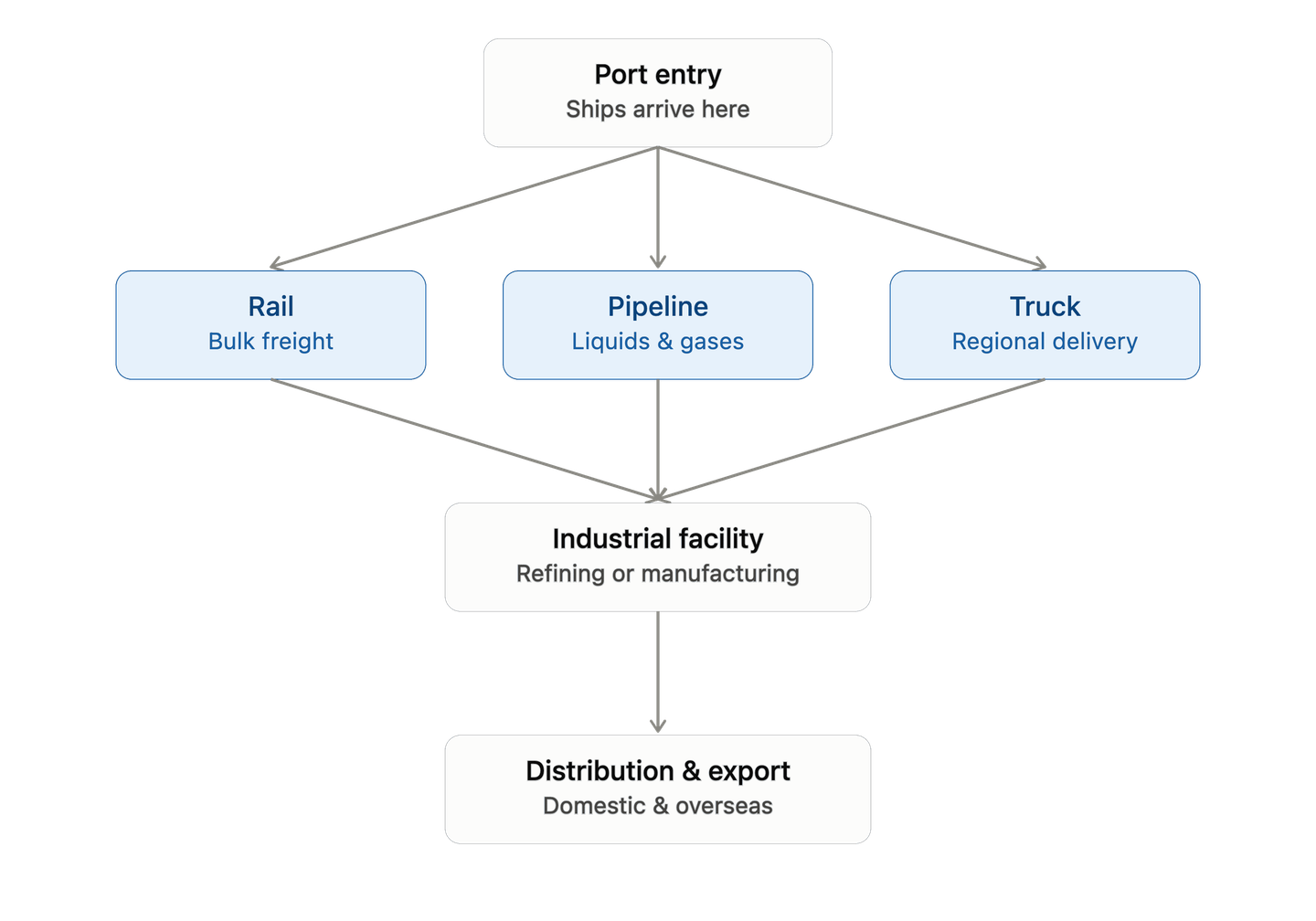
Once cargo and raw materials arrive at the port, they continue inland by whichever mode suits what is being moved. Rail carries bulk solids such as chemicals, steel, and machinery. Pipelines move liquids and gases, including crude oil, refined fuels, and natural gas liquids, directly between facilities. Trucks handle shorter, time-sensitive deliveries. All three modes ultimately feed the same refineries, petrochemical plants, and manufacturing facilities that make up the region’s industrial base, and finished products move back out through that same network toward domestic markets or export.
Aerospace & Other Major Industrial Sectors
Aerospace & Space Industry
NASA’s Johnson Space Center in Clear Lake anchors a cluster of aerospace engineering, spacecraft systems, and research and testing activity. This sector developed differently from the Ship Channel industries and is best understood as a separate, technically demanding part of Houston’s industrial story rather than folded into the energy narrative.
Maritime & Offshore Industries
Beyond cargo shipping, the region supports marine services, offshore energy operations, ship repair, marine fabrication, and vessel support industries tied to Gulf of Mexico activity.
Power & Energy Infrastructure
Power generation, electricity infrastructure, and natural gas supply underpin every other industrial sector in the region, and increasingly include energy-transition and lower-carbon technology investment.
Houston’s Industrial Workforce & Supporting Industries
Engineering & Technical Workforce
The region employs tens of thousands of engineers, technicians, inspectors, and skilled trades workers, including roughly 76,500 engineers, architects, and related technicians and more than 84,800 workers in computer and mathematical occupations across metro Houston (GHP, Talking Points).
Industrial Services
Refineries, petrochemical plants, and manufacturing facilities across the region operate under strict engineering and quality codes, including ASME pressure vessel and piping codes, API standards for tanks and refining equipment, and AWS welding codes. Because the district runs a near-constant mix of new construction, turnarounds, and maintenance shutdowns, plant owners depend on a deep local network of welding and fabrication contractors alongside metallurgical and non-destructive testing (NDT) providers. In practice, that work is closely linked: a weld or repair typically has to be procedure-qualified, inspected, and documented before a facility can return it to service. That tight loop between fabrication and testing is one reason the region supports so many specialized industrial service providers rather than a handful of generalists.
How Houston Became an Industrial Center
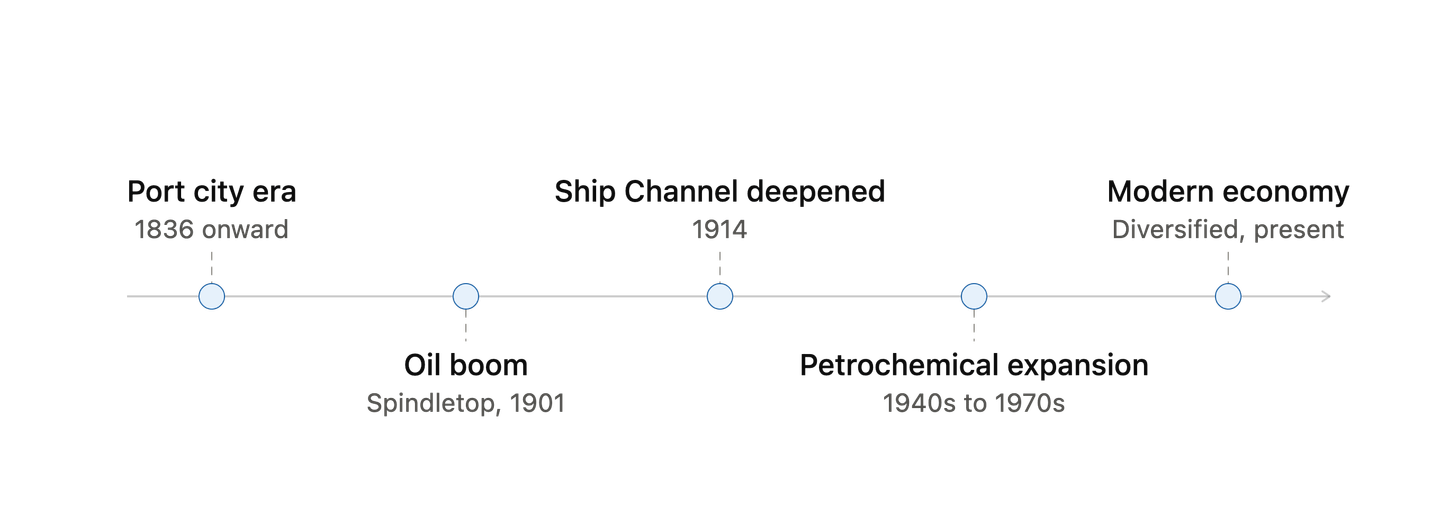
Industrial Houston began with transportation. Before the Ship Channel, Houston’s connection to ocean-going trade was limited by the shallow waters of Buffalo Bayou and the need to transfer cargo at Galveston. Local leaders pushed for a deep-water connection, and the Houston Ship Channel was ceremonially opened in November 1914, with Port Houston identifying the Turning Basin as the head of navigation at the time (Port Houston, Background & History). Once the waterway was established, refineries, terminals, pipelines, chemical plants, and manufacturing could locate close to water access and to one another. Over the following decades, highways, railroads, storage, and additional pipelines expanded the network, and Houston’s later growth in aerospace and advanced engineering added another technical layer to the regional economy.
Houston Industrial Infrastructure Map
Why Houston’s Industrial Geography Matters
Industrial facilities do not choose locations at random; they need access to materials, transportation, utilities, customers, workers, and other businesses. Houston’s industrial corridors developed because several of those requirements could be met in the same place: a facility near the Ship Channel can use marine transportation, a plant near a pipeline corridor can receive feedstocks, and a manufacturer near major highways can move equipment and finished products by truck. Once enough infrastructure is in place, the advantages compound: suppliers locate nearby, contractors gain access to a large customer base, and workers have more industrial employers within the same region. That pattern is a major reason Houston remains one of the country’s most important industrial centers.
Frequently Asked Questions
Is Houston’s industrial economy only about oil and gas?
No. Oil and gas are central, but the region also has major chemical, manufacturing, maritime, logistics, engineering, and aerospace activity.
Where is Houston’s main industrial area?
The Houston Ship Channel and surrounding corridor are the core, with major concentrations in Pasadena, Deer Park, La Porte, Baytown, Channelview, Galena Park, Texas City, and the Mont Belvieu area.
Why is the Houston Ship Channel important?
It connects the region to Galveston Bay and the Gulf of Mexico and provides marine access for energy products, chemicals, containers, steel, and other materials.
Why are so many chemical plants located around Houston?
The region combines feedstock availability with pipelines, ports, storage, transportation, and a large industrial customer base.
Does Houston have a large manufacturing industry?
Yes. Houston Facts 2025 counted 7,209 manufacturing establishments and 238,271 manufacturing employees regionwide.
Does the Houston industrial region stop at city limits?
No. Major industrial facilities are spread across neighboring municipalities and counties, which is why statistics on this page always state the geographic area they represent.
Sources & Further Reading
- Port Houston: Statistics
- Port Houston: Interactive Port Map
- Port Houston: Houston Ship Channel Report
- Port Houston: Background & History
- Port Houston: Breakbulk & Project Cargo
- U.S. EIA: Refinery Capacity Report
- U.S. EIA: Refinery Rankings explainer
- U.S. EIA: U.S. refining capacity decreased during 2025
- Greater Houston Partnership: Houston Facts 2025
- Greater Houston Partnership: Talking Points / regional data
- Greater Houston Partnership: Manufacturing powerhouse feature
- Houston-Galveston Area Council (H-GAC): Interactive Web Applications