Industrial Welding Services for the Maritime Industry
We are Houston’s top choice for maritime welding services. We bring nearly two decades of experience, craftsmanship, and the latest technology to the table.

Key Points
- Our advanced lab uses top-notch equipment for detailed weld checks and quality control.
- We use AI sensors and thermal imaging to monitor welding closely, with 1000 samples per second.
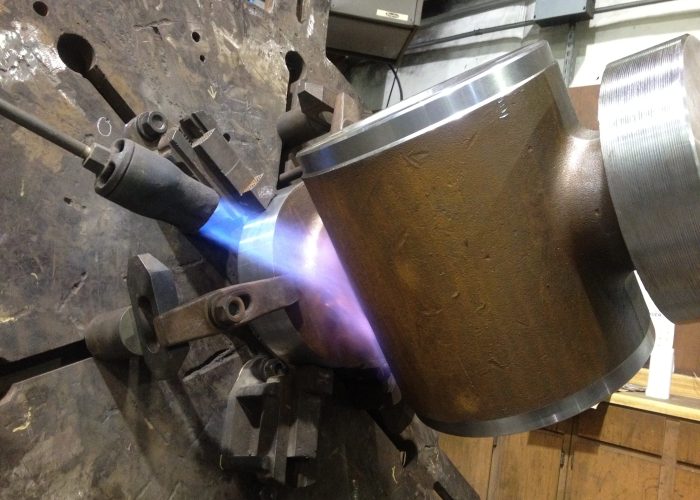
- AWS-certified welders handle hot-tapping, pressure vessel fixes, and special metal joining and assembly of structural components, all to international standards.
Our Expertise in Maritime Industry Welding
We’ve spent nearly two decades mastering shipbuilding and marine welding. Our techniques for high-pressure work meet strict standards.
Our professional welders use advanced hyperbaric systems and ROV tools for work over 200 meters. They’re experts in hot-tapping, pressure vessel repairs, and special metal joining, keeping structures strong in harsh marine conditions.
The marine industry needs a quick turnaround, so we’ve made our fabrication and welding services fast and efficient. Our team works with many advanced materials, including duplex stainless steel and nickel alloys, common in marine use.
As an ASME-certified weld testing facility, we offer welding procedure development and qualification for marine projects.
State-of-the-Art Equipment and Fabrication Facilities
Our advanced testing lab is equipped with world-class radiographic and ultrasonic tools for weld checks to ensure the structural integrity of weld joints.
Our systems provide real-time data on welding parameters like temperature and penetration depth. Quality control stations at each bay ensure we follow international standards and document every step.
Our nondestructive testing methods help find flaws early without damaging materials.
Advanced Testing Laboratory Setup
Modern welding needs precise quality control, which our lab provides. We have metallographic testing stations, digital radiography, and ultrasonic tools for detailed weld analysis.
Our lab has tensile testing machines, impact units, and hardness devices for mechanical property checks. Automated systems track and document test results in real-time.
Our climate-controlled lab ensures accurate measurements. We use certified tools and specialized software for detailed analysis. This ensures reliable, traceable test results for your projects.
Precision Welding Monitoring Systems
We’ve developed advanced welding monitoring systems for real-time quality checks. Our systems use AI sensors to track temperature, arc stability, and penetration depth. They process data at 1000 samples per second.
Our digital twin monitoring interface lets technicians see weld formation live. We use thermal cameras and high-speed videography to spot defects early. Our system keeps detailed records of every weld, meeting maritime industry standards.
Emergency Repair Services and Response Times
We have a team ready 24/7 for urgent welding repairs. They are equipped to handle emergencies across all service areas.
Our teams use non-destructive testing to find and fix welding problems quickly.
Quality Control and Industry Certifications
We focus on top quality in industrial welding. At WH Labs, we follow strict quality control steps. These steps meet international standards.
We hold important certifications that show our dedication to quality:
- AWS D1.1 Structural Welding Code certification for critical marine infrastructure
- API 1104 certification for pipeline and facilities welding operations
- ASME Section IX certification for pressure vessel and boiler fabrication
Our quality control team uses advanced NDT methods for inspections. These include radiographic testing, ultrasonic examination, and magnetic particle inspection. We provide detailed quality assurance reports that meet ABS, DNV-GL, and Lloyd’s Register standards.
Our certified experts use specialized NDT techniques for material evaluation. This ensures the safety of critical marine assets.
Safety Standards and Environmental Compliance
We deliver expert welding services while following strict safety protocols for hot work. These protocols exceed OSHA’s requirements and API RP 2D standards. Our safety management system integrates environmental protection with workplace safety.
We’ve implemented advanced fume extraction systems and proper waste disposal procedures. This minimizes our environmental impact. Our commitment to safety and sustainability is shown through:
- Regular third-party audits and certifications to maintain ISO 14001 and ISO 45001 standards
- Real-time monitoring of air quality and hazardous material exposure levels
- Advanced PPE requirements that surpass industry standards, including specialized respiratory protection and fire-resistant gear
Our team stays updated with evolving regulations through monthly training sessions. This keeps us as Houston’s safety leader in industrial welding. Our dedication to quality management systems aligns with ISO 9001:2015 principles. This ensures consistent service excellence and customer satisfaction.
Training and Professional Development Programs
We have a thorough training program with three main tracks. These tracks are AWS certification preparation, specialized equipment operation, and advanced metallurgy instruction. Each track builds competency through hands-on experience and theoretical knowledge.
In AWS certification preparation, we focus on code compliance and welding symbol interpretation. Our equipment operation track covers plasma cutters, automated welding systems, and non-destructive testing tools.
For advanced metallurgy, we explore material properties and heat treatment techniques. We also analyze weld chemistry.
We’ve partnered with industry leaders to provide our skilled welders with cutting-edge simulation technology. Our mentorship program pairs seasoned professionals with developing welders. This ensures knowledge transfer and skill retention. We maintain a 94% certification success rate through our structured approach to professional development.
Our commitment to quality is reinforced through our ISO 9001:2015 certification. This ensures consistent training standards.
Frequently Asked Questions
What Are Your Average Project Completion Timelines for Large-Scale Marine Repairs?
We finish large marine repairs in 2-4 weeks. This depends on the project’s complexity and size. Our process includes NDT testing, IACS certifications, and third-party inspections.
What Types of Marine Welding Projects Do You Handle at Your Facility?
Onshore fabrication and repair of vessel components, marine hardware, or structural parts.
Takeaway
At WH Labs, we’re dedicated to providing critical welding solutions for the Gulf Coast. Our 24/7 emergency response, ISO-certified welding processes, and ROV-integrated systems ensure quality in every project.