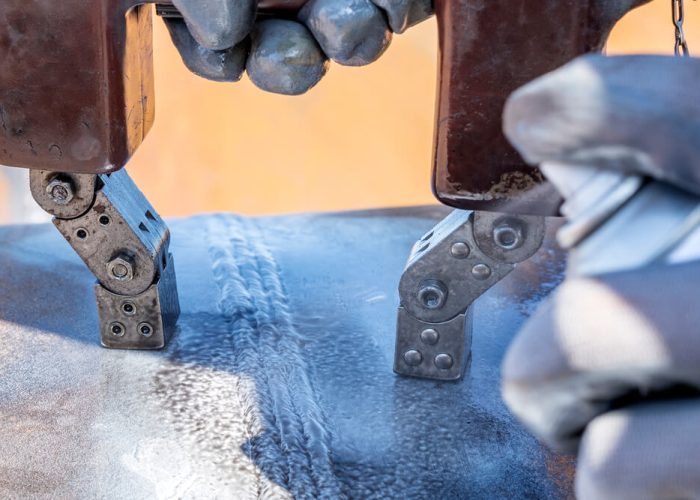
What is Non-Destructive Testing?
As we delve into the field of Non-Destructive Testing (NDT), we’re faced with a captivating mix of science, technology, and practical application. We’ve come to depend on these techniques to guarantee the safety and integrity of numerous structures and components in our daily lives, often without even realizing it. From the planes we fly in to the bridges we cross, NDT plays an essential role in preventing failures and extending the lifespan of critical infrastructure. But what exactly goes into these testing methods, and how are they evolving to meet the demands of our progressively intricate world?

Key Points
- Non-destructive testing evaluates materials without causing damage, preserving integrity while detecting flaws.
- Common NDT techniques include visual inspection, ultrasonic testing, and radiography for various applications.
- NDT is crucial in industries like aerospace, aviation, and oil and gas for safety and reliability.
- Certification and training in NDT are essential for career development and maintaining quality standards.
- Emerging technologies like terahertz imaging and AI are advancing NDT capabilities for improved defect detection.
Principles of Non-Destructive Testing
Non-Destructive Testing (NDT) operates on the fundamental principle of material evaluation without causing damage or altering the object’s properties. As a certified NDT company in Houston, TX, we employ various techniques to inspect materials, safeguarding their integrity and reliability without compromising their structural soundness. Our methods allow us to identify defects that could potentially lead to catastrophic failures in critical components across industries. We utilize advanced NDT methodologies to guarantee timely defect identification, leveraging high-tech tools to prevent structural failures by identifying weak spots in materials.
We adhere to specific standards and codes, maintaining rigorous quality control and safety measures. By utilizing techniques such as ultrasonic testing, radiography, and magnetic particle inspection, we can detect flaws like cracks, voids, and inclusions that may not be visible to the naked eye. These nondestructive principles enable us to thoroughly examine materials while preserving their functionality.
In our field, we recognize the vital role NDT plays in industries such as aerospace, oil & gas, and manufacturing. By applying these principles, we contribute to preventing failures and ensuring the longevity of essential components.
As skilled technicians, we’re united in our commitment to upholding the highest standards of material integrity through the application of NDT principles.
Common NDT Techniques
In exploring common NDT techniques, we’ll examine visual inspection methods, ultrasonic testing applications, and radiography in NDT. Visual inspection, often the first step in NDT, relies on trained operators to detect surface anomalies using direct or remote visual aids. This method acts as a preventive measure, meticulously scanning surfaces to identify flaws and ensure compliance with quality standards.
Ultrasonic testing employs high-frequency sound waves to identify internal flaws, with advanced methods like PAUT and TOFD offering enhanced detection capabilities.
Radiographic testing utilizes penetrating radiation to reveal internal discontinuities, providing a thorough view of a material’s structural integrity.
Visual Inspection Methods
Among the various NDT techniques, Visual Inspection (VT) stands out as one of the most essential and widely used methods. As fellow practitioners in the field of non-destructive testing, we’ve come to rely on VT for its effectiveness in surface-level assessments. This technique allows us to detect visible defects, surface irregularities, and corrosion in materials using our naked eye or specialized tools like remote visual inspection cameras.
With advancements in digital X-ray machines and ultrasonic flaw detectors, VT can be complemented by more sophisticated methods for enhanced accuracy.
We appreciate VT for its non-intrusive nature and cost-effectiveness, providing us with real-time results that enable quick decision-making during inspections. It’s often our go-to preliminary step in NDT, helping us identify areas that may require further examination with more advanced techniques.
In our industry, we recognize the pivotal role VT plays in quality control, maintenance checks, and safety inspections across various sectors. As NDT professionals, we value its versatility and reliability. By employing visual inspection methods, we contribute to ensuring the integrity and safety of structures and components, reinforcing our commitment to excellence in non-destructive testing practices.
Ultrasonic Testing Applications
Versatility characterizes ultrasonic testing (UT) as a cornerstone of non-destructive evaluation. We depend on this powerful technique to detect flaws and internal defects in a wide range of materials and components. By utilizing high-frequency sound waves, we can peer into the core of vital components without compromising their integrity.
In our industry, we’ve come to value UT’s effectiveness in inspecting welds, pipelines, and structural elements across aerospace, manufacturing, and oil & gas sectors. We’re able to identify cracks, voids, and thickness variations with remarkable accuracy, ensuring the safety and reliability of our most essential assets.
The process involves sending ultrasonic waves into the material and analyzing the reflected signals. This non-destructive inspection method allows us to assess material integrity without causing harm. We’ve found UT to be invaluable in maintaining quality control and preventing potential failures.
As we endeavor for excellence in our field, ultrasonic testing continues to demonstrate its value. It’s not just a tool; it’s our assurance that the components we rely on daily meet the highest standards of safety and performance.
Radiography in NDT
Radiography stands alongside ultrasonic testing as a cornerstone of non-destructive evaluation. As a powerful NDT technique, industrial radiography harnesses the penetrating power of X-rays or gamma rays to expose the hidden internal structure of materials. We rely on this method to detect a wide range of internal flaws, including cracks, voids, inclusions, and weld discontinuities that might compromise material integrity.
One of radiography’s key strengths is its ability to provide detailed images of internal components, allowing us to accurately evaluate the condition of critical structures. This nondestructive approach proves invaluable in industries where safety and reliability are paramount, such as aerospace, oil & gas, and manufacturing. We use radiography to guarantee the quality and integrity of critical components without causing any damage to the materials under inspection.
As fellow professionals in the NDT field, we comprehend the importance of having reliable tools at our disposal. Radiography’s effectiveness in revealing hidden defects makes it an indispensable technique in our arsenal.
Industries Utilizing NDT
We’ll examine two pivotal industries that extensively employ NDT: Aerospace and Aviation, and the Oil and Gas Sector.
In aerospace and aviation, NDT is essential for ensuring the structural integrity of aircraft components, detecting minute flaws that could lead to catastrophic failures.
The oil and gas industry relies heavily on NDT for inspecting pipelines, storage tanks, and offshore platforms to prevent leaks, corrosion, and potential environmental disasters.
Aerospace and Aviation
Aircraft safety hinges on the rigorous application of Non-Destructive Testing (NDT) in the aerospace and aviation industries. We rely on NDT methods like radiography and ultrasonic testing to detect defects in critical aerospace structures, ensuring the integrity of components without compromising their functionality. These techniques play a crucial role in preventing catastrophic failures, thereby enhancing passenger safety and maintaining the reliability of aircraft.
In our industry, NDT technicians undergo specialized training to meet stringent standards for inspection and maintenance. We’re committed to upholding the highest levels of quality control and compliance with aviation regulations. By employing NDT, we’re able to implement efficient maintenance practices that keep our aircraft in top-notch condition.
Our collective efforts in applying NDT to aerospace and aviation contribute to a safer, more reliable air travel experience for everyone. We’re part of a community dedicated to pushing the boundaries of technology while prioritizing safety. Through our meticulous approach to NDT, we’re not just inspecting components; we’re safeguarding lives and upholding the trust placed in us by passengers and regulatory bodies alike.
Oil and Gas Sector
Pipelines and pressure vessels form the backbone of the oil and gas industry, where Non-Destructive Testing (NDT) plays a pivotal role in maintaining operational integrity. We depend on NDT techniques like ultrasonic testing and radiography to detect corrosion, cracks, and defects in our essential equipment. By investing in these inspection methods, we confirm compliance with regulatory standards and prolong the lifespan of our assets.
Let’s explore the key benefits of NDT in our sector:
| Benefit | Description | Impact |
| Safety | Prevents accidents | Protects workers and environment |
| Cost savings | Identifies issues early | Avoids costly repairs and downtime |
| Compliance | Meets industry standards | Maintains operational licenses |
| Asset longevity | Extends equipment life | Improves ROI on infrastructure |
| Efficiency | Optimizes maintenance | Reduces unnecessary replacements |
As members of the oil and gas industry, we grasp the significance of skilled NDT technicians in our operations. Their expertise in corrosion detection and equipment inspection is essential for preventing failures and ensuring operational safety. By embracing NDT, we’re not just meeting regulatory requirements; we’re safeguarding our industry’s future and protecting our shared environment.
Advantages of NDT Methods
The advantages of Non-Destructive Testing (NDT) methods are numerous and significant. As members of the Society for Non-destructive Testing, we grasp the critical role these techniques play in guaranteeing safety and reliability across industries. NDT methods like ultrasonic testing and radiography NDT provide us with precise detection of internal defects without compromising the integrity of the materials we’re examining. This non-invasive approach allows us to inspect critical components thoroughly while preserving their structural integrity.
We’ve discovered that NDT methods offer cost-effective solutions for examining welds, pipelines, and structural components. By pinpointing flaws early in components such as pressure vessels and bridges, we can prevent catastrophic failures and secure public safety. Our testing methods, including magnetic particle inspection and eddy current testing, are essential for upholding product integrity and quality control.
As professionals in this field, we’re dedicated to utilizing these advantages to enhance safety standards and reliability in aerospace, oil and gas, and construction industries. Through NDT, we’re able to provide peace of mind and guarantee the longevity of critical infrastructure that impacts our daily lives.
Certification and Training Requirements
For NDT professionals, certification and training requirements are essential components of our career development and industry credibility. We acknowledge the importance of NDT certification in demonstrating our proficiency across various testing methods. ASNT, a globally respected organization, offers certification programs that we can pursue to validate our expertise.
As we progress in our careers, we encounter different certification levels, ranging from Level 1 for entry-level positions to Level 3 for expert practitioners. These certifications not only guarantee our compliance with industry standards but also greatly improve our employability in the NDT field.
We’ve noticed that central certification schemes have gained prominence, providing standardized recognition for NDT personnel across different regions and industries.
This uniformity in certification helps us maintain consistent quality standards and facilitates our mobility within the global NDT community.
Emerging Technologies in NDT
As we advance in our NDT careers, staying abreast of emerging technologies becomes paramount. Terahertz nondestructive evaluation is revolutionizing our field, offering high-resolution imaging and material characterization capabilities that were previously unattainable.
We’re witnessing the integration of robotic NDT systems, which allow us to access confined spaces and hazardous environments while ensuring precise data collection.
We’re also embracing the concept of NDE 4.0, which combines AI, IoT, and big data analytics to enhance our inspection efficiency and accuracy. This shift towards smart, interconnected systems is transforming how we approach NDT. Predictive maintenance techniques are now at the forefront, utilizing real-time data and machine learning algorithms to forecast equipment failures before they occur.
Advanced materials science is shaping our understanding of material behavior and defect detection, leading to more sophisticated NDT methods. As we incorporate these emerging technologies into our practice, we’re not just improving our capabilities; we’re redefining the boundaries of what’s possible in NDT. By embracing robotic inspections and cutting-edge material characterization techniques, we’re positioning ourselves at the forefront of this rapidly evolving field.
Challenges and Future Developments
Traversing the complex terrain of NDT presents us with a myriad of challenges that we must address to advance our field. Intricate geometries, material variety, and accessibility limitations pose significant hurdles in our inspections. We’re constantly working hard to detect hidden defects and improve signal-to-noise ratios to guarantee reliable results.
To overcome these obstacles, we’re embracing future developments that integrate cutting-edge technologies. Let’s explore the challenges and corresponding advancements:
| Challenge | Future Development |
| Intricate geometries | Robotics integration |
| Material variety | AI and machine learning |
| Accessibility limitations | Advanced sensor technology |
| Hidden defects | Terahertz imaging |
By leveraging robotics, we’re enhancing our ability to inspect complex structures. AI and machine learning algorithms are revolutionizing our approach to diverse materials, while advanced sensor technology is improving our reach in confined spaces. Terahertz imaging is emerging as a powerful tool for detecting hidden defects.
As we move forward, data analytics will play an essential role in processing the vast amounts of information gathered during inspections. These advancements will greatly enhance our accuracy and efficiency, ensuring we remain at the forefront of NDT innovation.
Frequently Asked Questions
What Are the 5 Most Common Testing in Ndt?
We commonly employ five NDT methods: Visual Testing for surface evaluations, Ultrasonic Testing for internal flaw detection, Radiography Testing for revealing structural defects, Eddy Current Testing for near-surface flaws, and Magnetic Particle Inspection for ferromagnetic materials.
What Are the Four Types of Ndt?
We’ve identified four primary NDT types: Visual Testing, Ultrasonic Testing, Radiography Testing, and Eddy Current Testing. These methods allow us to inspect materials without causing damage, ensuring we maintain integrity while detecting potential flaws in our structures.
What Does an NDT Technician Do?
We inspect materials without causing damage. We use techniques like ultrasonic testing and radiography to identify defects in structures and products. Our expertise guarantees safety and quality across industries, preventing potential failures in critical infrastructure.
What Are the Different Types of NDE Tests?
Let’s explore the main NDE tests we commonly use: ultrasonic testing (UT), radiographic testing (RT), magnetic particle testing (MT), liquid penetrant testing (PT), and visual testing (VT). Each method offers unique advantages for detecting flaws in various materials.
Takeaway
We’ve examined the critical role of Non-Destructive Testing in ensuring material integrity across industries. We’ve analyzed various NDT techniques, their applications, and the advantages they offer. We’ve explored certification requirements and emerging technologies in the field. As we look to the future, we’ll continue to face challenges in NDT implementation, but we’re confident that ongoing advancements will further enhance our ability to detect defects and prevent failures non-invasively.