Common Welding Defects: Causes, Remedies, and Prevention of Weld Defects
Welding is a critical process in many industries, ensuring the integrity and strength of metal structures. However, various factors can lead to imperfections, commonly known as weld defects, which can compromise the structural integrity of the weld joint. Understanding the common types of welding defects, their causes, and effective remedies is essential for maintaining high-quality welding standards and preventing future issues.
Understanding Common Welding Defects
Welding defects are imperfections that can occur during the welding process, affecting the quality and strength of the weld. These defects can range from minor visual flaws to severe internal issues that compromise the structural integrity of the weld. Recognizing and addressing these problems is crucial for ensuring the reliability and safety of welded structures.
What is a Weld Defect?
A weld defect is essentially any flaw or discontinuity that compromises the intended quality and performance of a weld. These defects are imperfections arising from various factors, including improper welding techniques, incorrect welding parameters, or contamination. Weld defects can manifest as surface imperfections or internal defects, and identifying them early through visual inspection and other non-destructive testing methods is critical to prevent potential failures. Some welding problems can be fixed during the welding process, whereas some require a full grinding and re-welding of the affected area.
Importance of Identifying Weld Defects
Identifying weld defects is of paramount importance as these imperfections can significantly weaken the weld joint, leading to potential failures and safety hazards. The presence of defects can reduce the load-bearing capacity of the welded structure and increase the risk of cracking or fracture under stress. Early detection and remediation of common welding defects ensure the structural integrity and longevity of welded components, which in turn helps avoid costly repairs and ensures safety.
Overview of Common Types of Welding Defects
Several common types of welding defects can occur during various welding processes, such as arc welding, TIG welding, and MIG welding. Some of these defects are:
- Porosity in welding (small bubbles trapped in the weld metal)
- Cracks (fractures in the weld or base metal)
- Undercut (grooves at the toe of the weld)
- Incomplete penetration (failure of the weld metal to fuse completely through the joint)
- Slag inclusion (non-metallic impurities trapped in the weld)
Understanding the causes and remedies for each type of weld defect is crucial for professional welding engineers and welders to ensure high-quality weldments.
Types of Weld Defects
Porosity in Welding
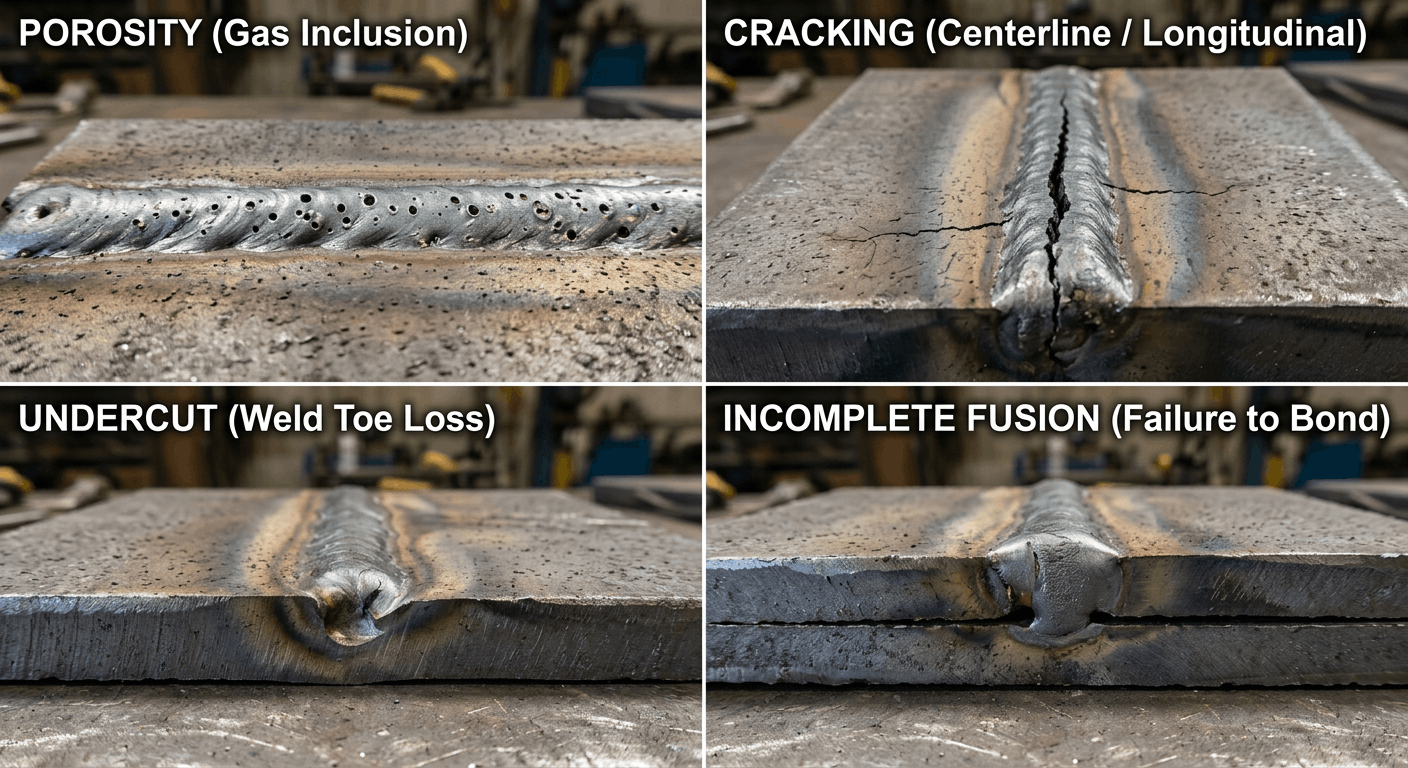
Porosity in welding refers to the presence of holes in the weld pool due to trapped gas bubbles. This common welding defect weakens the weld joint, reducing its strength and fatigue resistance. Porosity occurs due to gases released from the molten weld pool solidifying before they can escape, often caused by contamination or improper shielding gas coverage during the welding process.
Welding Cracks
Welding cracks are fractures that occur in the weld metal or adjacent base metal. These cracks are significant defects that can propagate under stress, leading to structural failure. Welding cracks often arise from high welding stresses, rapid cooling rates, or the presence of contaminants. The weld procedure must be correct to help prevent cracks.
Lack of Fusion and Incomplete Penetration
Lack of fusion and incomplete penetration occur when the weld metal fails to properly fuse or bond with the base metal throughout the joint thickness. This common welding defect results in reduced weld strength and can lead to premature failure. Lack of fusion is caused by incorrect welding parameters, such as low welding current or incorrect welding technique, and improper joint preparation.
Undercut and Slag Inclusion
Undercut is a groove or channel formed in the base metal along the toe of the weld, reducing the cross-sectional thickness and weakening the joint. Undercut is a common welding defect that arises from excessive current, incorrect welding technique, or improper electrode angle. Slag inclusion refers to non-metallic impurities like slag trapped in the weld metal. This defect is common to processes that use flux, such as stick welding, flux-cored, submerged arc welding, and brazing.
Overlap
Overlap occurs when the weld metal extends beyond the edge of the joint without fusing to the base metal. This imperfection creates a stress concentration point, increasing the risk of cracking and fatigue failure. Overlap is often caused by improper welding technique, such as excessive weld metal deposition or incorrect electrode manipulation during the welding process.
Spatter and Crater Defects
Spatter refers to small droplets of molten metal that are expelled from the welding arc and adhere to the surface of the base metal adjacent to the weld. Excessive spatter can indicate unstable welding conditions or incorrect welding parameters. Crater cracks are depressions that form at the end of a weld bead when the welding arc is terminated abruptly.
Burn-Through
Burn-through occurs when excessive heat input during the welding process causes the weld metal to melt completely through the base metal, creating a hole or opening in the joint. This defect compromises the structural integrity of the weld. This defect is common in thin materials or when using high welding currents or slow travel speeds.
Under Filled
An underfilled weld occurs when the weld metal does not completely fill the weld joint, leaving a depression or groove on the weld surface. This defect reduces the effective thickness of the weld and weakens the joint. Underfill is often caused by insufficient weld metal deposition, incorrect welding parameters, or improper welding technique during the welding process.
Excess Reinforcement
Excessive reinforcement refers to weld metal that extends excessively beyond the surface of the base metal, creating an unnecessarily large and convex weld bead. While some reinforcement is necessary for weld strength, excessive reinforcement can create stress concentrations and increase the risk of fatigue failure. Controlling weld parameters is important.
Mechanical Damage
Mechanical damage to a weld can occur from various external factors, such as impact, abrasion, or improper handling. This can result in dents, scratches, or gouges on the weld surface, which can compromise the weld’s integrity. Such damage can initiate cracks or other defects, reducing the weld’s load-bearing capacity and increasing the risk of failure under stress.
Distortion
Distortion refers to changes in the shape or dimensions of the base metal caused by the heat generated during welding. Welding distortion is a common issue, particularly in thin materials or when welding large structures. Heat input causes expansion and contraction of the metal, which leads to residual stresses and subsequent deformation after cooling.
Misalignment
Misalignment occurs when the edges of the base metal are not properly aligned before welding, resulting in an offset or step in the joint. This defect can significantly reduce the strength and fatigue resistance of the weld. Misalignment creates stress concentrations at the joint, increasing the risk of cracking and failure under load.
Whiskers
Whiskers, also known as wire whiskers, are short lengths of welding wire that protrude from the weld metal. These whiskers can occur in welding processes, particularly in MIG welding, where the welding wire is fed continuously. They are often caused by improper welding parameters, such as excessive welding current, incorrect welding technique, or contaminated welding wire.
Causes of Welding Defects
Common Causes of Porosity
Porosity, a common welding defect, arises when gases get trapped in the weld metal during solidification. The causes of porosity can vary, but often include contamination of the welding surface, such as rust, moisture, or oil, which releases gases into the molten weld pool. Improper shielding gas coverage can also lead to porosity, as it fails to protect the weld pool from atmospheric contamination.
Factors Leading to Welding Cracks
Welding cracks can be a serious type of weld defect, often resulting from a combination of factors that create stress concentrations within the weld joint. High welding stresses caused by rapid heating and cooling cycles can exceed the material’s tensile strength, leading to crack formation. Furthermore, the presence of contaminants or inclusions in the weld metal can act as initiation points for cracks. Selecting the correct welding procedure and filler is crucial.
Discontinuities: Incomplete Fusion and Penetration
Incomplete fusion and incomplete penetration are discontinuities that compromise the structural integrity of the weld joint. Incomplete fusion occurs when the weld metal fails to properly fuse with the base metal, leaving gaps or voids along the joint interface. This lack of fusion reduces the weld’s load-bearing capacity and increases the risk of failure. Incorrect welding patterns or improper joint preparation are often to blame.
How to Detect Welding Defects
Non-Destructive Testing
Non-destructive testing (NDT) methods are crucial for identifying defects without compromising the integrity of the weld. These techniques allow for thorough inspection and analysis of weld quality without damaging the component. WH Labs specializes in advanced NDT techniques, such as ultrasonic testing (UT), radiography (RT), magnetic particle (MT), or dye penetrant (PT), to detect both surface and internal welding defects. Our advanced NDT services in Houston, TX can reveal any imperfection.
Destructive Testing
Destructive testing involves physically testing the weld joint to assess its mechanical properties and structural integrity. These tests provide valuable information about the weld’s strength, ductility, and resistance to failure, but they also render the tested specimen unusable. Common destructive testing methods include tensile testing, bend testing, and impact testing.
Remedies for Welding Defects
Effective Solutions for Porosity
Addressing porosity requires a multi-faceted approach focused on preventing gas entrapment in the weld metal. Thoroughly cleaning the base metal to remove contaminants is essential, as is ensuring adequate shielding gas coverage to protect the weld pool from atmospheric contamination. Adjusting welding parameters, such as welding current and travel speed, can also help reduce porosity in welding and improve weld quality. It is very important to select the right arc length.
Repairing Welding Cracks
Repairing welding cracks typically involves removing the cracked weld metal and re-welding the joint. The welding procedure must be carefully controlled to prevent the recurrence of cracks. Preheating the base metal can reduce thermal stresses, while using low-hydrogen electrodes can minimize the risk of hydrogen-induced cracking. Qualified welders are essential for performing crack repairs to ensure the weld is free of internal defects.
Improving Fusion and Penetration
Improving fusion and penetration requires careful control of welding parameters and proper joint preparation. Increasing the welding current or reducing the welding speed can increase heat input, promoting better fusion and penetration. Ensuring the correct electrode angle and arc length is also crucial for achieving adequate fusion. Certified welders with proven techniques can help solve fusion and penetration problems. Improper welding techniques are the main cause.
Preventing Welding Defects
Best Practices in MIG and TIG Welding
To minimize weld defects in MIG and TIG welding, meticulous attention to detail and adherence to best practices are essential. Precise control over welding parameters, such as welding current, arc voltage, and travel speed, is crucial for achieving optimal weld quality. Proper torch angle and consistent arc length also play a significant role in preventing welding defects like porosity and undercut.
Importance of Qualified Welders
Engaging qualified welders is paramount to ensure high-quality welds and minimize the risk of defects. Plant maintenance supervisors face difficulty in sourcing qualified welders for specialized repairs. Certified welders possess the necessary skills and knowledge to execute Welding Procedure Specifications (WPS) correctly. They are trained to identify and address potential issues that can lead to weld defects, like cracking or lack of fusion, reducing the likelihood of problems. WH Labs offers advanced welding services in Houston, TX with a team of certified welders and inspectors.
Regular Inspection and Maintenance
Regular visual inspection and maintenance of welding equipment are critical for preventing weld defects and ensuring consistent weld quality. Inspecting welding machines, electrodes, and shielding gas systems can help identify potential problems before they lead to welding defects. Maintaining clean and properly functioning equipment ensures stable welding conditions and minimizes the risk of contamination, which can cause porosity and other imperfections.
Conclusion
Understanding the causes, remedies, and prevention methods for common welding defects is essential for maintaining structural integrity and ensuring safety. Addressing defects such as porosity, welding cracks, undercut, and lack of fusion requires careful attention to welding parameters, proper joint preparation, and the use of qualified welders. Regular visual inspection and maintenance are also crucial for preventing weld defects.
The Importance of Quality in Welding Services
Quality in welding services is of utmost importance for ensuring the reliability and longevity of welded structures. Welding engineers need to ensure quality. High-quality welds provide structural integrity, prevent failures, and minimize the need for costly repairs. Engaging experienced and certified welders, along with implementing robust quality control measures, guarantees that weld joints meet the required standards. This also ensures the safety of the weld joint and those who will use the weld.
FAQs
Which weld fault is the most serious?
Welding cracks are generally considered the most serious type of weld defect due to their potential to propagate under stress, leading to catastrophic failures. Even small cracks can significantly weaken the weld joint and compromise the structural integrity of the entire structure. Therefore, detecting and repairing welding cracks promptly is critical for ensuring safety and preventing failures.
Can welding defects be repaired?
Many welding defects can be repaired, depending on the type and severity of the defect. Minor surface imperfections like spatter or slight undercut can often be addressed through grinding or re-welding. More significant defects, such as welding cracks or lack of fusion, may require the complete removal of the defective weld metal and re-welding with proper techniques and parameters to ensure a sound and reliable repair.
Will welding defects cause damage?
Yes, welding defects can cause significant damage to structures and equipment, potentially leading to failures, accidents, and costly repairs. Weld defects weaken the weld joint, reducing its load-bearing capacity and increasing the risk of cracking or fracture under stress. If left unaddressed, welding defects can compromise the safety and reliability of welded components, resulting in severe consequences.