Accredited Tensile Testing Lab Houston, TX
We’ve all encountered materials that stretch, bend, or break under stress, but have you ever wondered how engineers determine a material’s limits? That’s where tensile testing comes in. WH Lab provides comprehensive testing services at our fully-equipped Houston lab with fast turnaround times without compromising quality and accuracy. It’s an essential process we use to measure how materials behave when pulled apart at a constant rate. By subjecting samples to controlled forces, we can uncover critical information about strength, elasticity, and breaking points. This knowledge isn’t just academic—it’s necessary for everything from building bridges to designing spacecraft.
Key Points
- Tensile testing evaluates a material’s mechanical properties, including ultimate tensile strength, yield strength, and modulus of elasticity.
- Universal testing machines, equipped with load cells, grips, and extensometers, are essential for conducting tensile tests.
- Proper specimen preparation and adherence to testing standards (e.g., ASTM, ISO) ensure reliable and consistent results.
- Stress-strain curves generated from tensile tests provide crucial data for analyzing material behavior and properties.
- Tensile testing services are vital across industries, including aerospace, automotive, construction, and biomedical, for quality assurance and product development.
Fundamentals of Tensile Testing
The essence of tensile testing lies in its ability to reveal a material’s fundamental mechanical properties. As we explore this vital facet of materials science, we’ll investigate how this testing method provides invaluable insights into the behavior of materials under stress.
Tensile testing involves subjecting a specimen to a gradually increasing force until it fractures. It might be performed under ambient or controlled (from cryogenic to high-temperature) conditions. This process allows us to measure key parameters such as ultimate tensile strength (UTS) and yield strength. These values are crucial for understanding a material’s performance limits and suitability for various applications.
Tensile testing also provides data on the modulus of elasticity, which reflects a material’s ability to return to its original shape after deformation. For further analysis, a stress-strain curve is plotted to understand the material’s behavior under tension.
Our NADCAP (National Aerospace and Defense Contractors Accreditation Program)and A2LA (American Association for Laboratory Accreditation) ISO/IEC 17025 accredited lab offers a complete range of metallurgical laboratory services. As fellow engineers and scientists, we recognize the significance of tensile testing in industries like aerospace, automotive, and construction. It’s through this testing that we can determine a material’s ductility, toughness, and stiffness – properties that are essential for ensuring the safety and reliability of structures and components.
Types of Materials Tested
Delving into the diverse realm of materials science, we encounter a wide array of substances subjected to tensile testing. We regularly evaluate mechanical properties of different materials, ranging from tire rubber and rebar to plastics, thin films, polymers, composites, fabrics, and metals. Each material responds uniquely to tensile forces, making it vital for us to test this diverse range to understand their behavior under various loading conditions. These tests are necessary for evaluating materials’ integrity and ensuring accurate final products.
Our testing applications yield crucial data on ultimate tensile strength, modulus of elasticity, elongation, and breaking force specific to each material. This information is priceless across industries where we utilize different materials, such as automotive, construction, biomedical, and consumer products. By conducting tensile tests, we gain insights into how materials perform under stress, allowing us to make informed decisions about their suitability for specific applications.
As we explore the mechanical properties of these varied substances, we’re not just gathering data; we’re building a thorough understanding of material behavior. This knowledge enables us to push the boundaries of material science, developing innovative solutions and improving existing products.
Together, we’re advancing our collective understanding of materials and their potential applications.
Tensile Testing Equipment
In our examination of tensile testing equipment, we’ll focus on three critical components: universal testing machines, grips and fixtures, and extensometers and sensors.
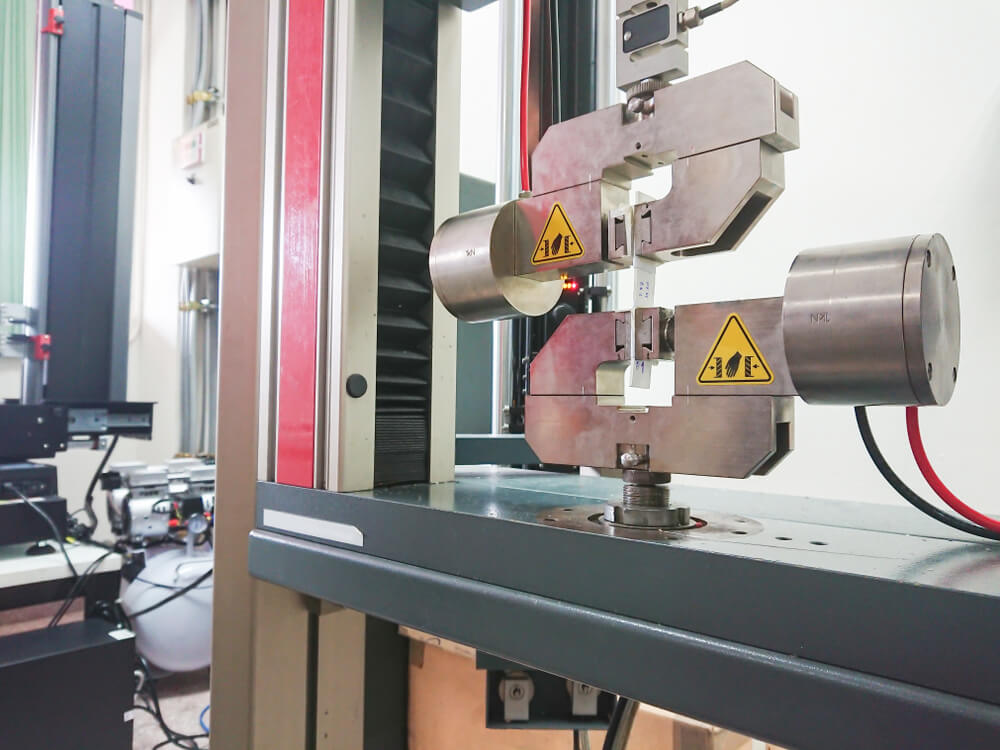
Universal testing machines, such as Instron’s 6800 Series, form the core of tensile testing setups, providing controlled force application. These machines are essential for accurate weld testing and other critical assessments.
We’ll explore how grips and fixtures secure various specimen shapes, ensuring consistent and repeatable testing conditions.
Additionally, extensometers and sensors precisely measure strain and elongation and reduction in area (percent change from original cross-sectional area) during tensile testing, offering detailed insights into material performance.
Universal Testing Machines (UTM)
Understanding the role of universal testing machines is necessary for conducting accurate tensile tests. These versatile instruments are the backbone of materials testing, allowing us to evaluate mechanical properties through various force applications. We’ll explore how these machines work and why they’re vital for our field.
UTMs are equipped with key components that enable precise measurements:
| Component | Function |
| Load cells | Measure applied forces |
| Grips | Securely hold test specimens |
| Extensometers | Measure strain and deformation |
| Control system | Manage test parameters and data |
These components work together to provide detailed data on material behavior under stress. We also use UTMs for compression, flexure, and peel tests. This versatility allows us to analyze a wide range of materials efficiently.
Popular models like Instron’s 6800 Series and servohydraulic systems offer high-precision testing capabilities. When conducting tensile tests, we often employ pneumatic side action grips to guarantee specimens are held securely throughout the test. By utilizing these advanced machines, we can obtain precise and dependable data on material properties, enabling us to make well-informed decisions in material selection and product development.
Grips and Fixtures
Selecting appropriate handles and fixtures is paramount for accurate tensile testing. These essential components play a vital role in securing specimens and guaranteeing reliable results. We must carefully choose handles based on the material being tested, as different types, such as wedge handles and pneumatic handles, offer distinct advantages for specific materials.
Handles are designed to prevent slippage and premature specimen failure during the application of tensile forces. This is crucial for obtaining accurate data on the mechanical properties of materials under tension.
Fixtures, on the other hand, help us align specimens properly within the machine, ensuring consistent and precise results.
As we conduct tensile tests, we must remember that the choice of handles and fixtures can greatly impact our data. By selecting the right components, we guarantee that our results accurately reflect the material’s true mechanical properties. We also make sure to calibrate our tensile testing equipment and choose handles and fixtures that best suit our specific testing needs and materials. This approach will help us achieve the most reliable and meaningful results in our material testing endeavors.
Extensometers and Sensors
Measuring material deformation accurately is important for thorough tensile testing, which is where extensometers and sensors come into play. These devices are vital in our analysis of material behavior under tensile forces. We use an extensometer to measure the elongation or strain of a specimen during testing, providing us with precise data on how the material deforms.
As we subject materials to tension, extensometers can be attached directly to the specimen, allowing us to monitor changes in length with high accuracy. This information is invaluable for determining key parameters such as Young’s modulus, yield strength, and ultimate tensile strength.
We’ve various types of extensometers at our disposal, including contact and non-contact versions, giving us flexibility in strain measurement across different materials.
The data we collect from extensometers and sensors enables us to gain deep insights into material properties. By analyzing the relationship between applied force and elongation, we can better understand how materials behave under stress and predict their performance in real-world applications. This knowledge is essential to our field, allowing us to make informed decisions in material selection and design optimization.
Specimen Preparation Techniques
Proper specimen preparation is a critical step in conducting accurate tensile tests. We must make sure that our test samples meet standardized dimensions and nomenclature to obtain reliable data.
We begin by machining standardized cross-sections with shoulders and gauge sections. These carefully crafted geometries are essential for achieving accurate results. Various shoulder styles are utilized to securely grip the specimens during testing, preventing slippage and maintaining consistent axial stretching load application.
| Material Source | Preparation Method | Key Considerations |
| Castings | Machining | Porosity control |
| Forgings | Grinding | Residual stress |
| Bar Stock | Turning | Surface finish |
| Sheet Metal | Stamping | Edge condition |
Our specimens can be prepared from castings, forgings, or bar stock, depending on the material and application. Regardless of the source, we must conform to standardized dimensions to guarantee consistency across tests and testing laboratories.
Tensile Testing Standards, Specifications, and Procedures
Standards form the backbone of tensile testing procedures, guaranteeing consistency and reliability across laboratories and industries. We rely on organizations like ASTM, ISO, AWS, ASME, and others to set these essential guidelines and quality system requirements. For plastics, we follow ASTM D638, while ASTM E8 governs metal testing. These standardized protocols dictate every aspect of the testing process, from specimen preparation to data analysis.
Many industries—aerospace, automotive, and construction—depend on the precision and reproducibility of these tests for quality control and material research. We prepare specimens with specific geometries, often in dogbone shapes, to guarantee accurate results.
Through rigorous adherence to these standards and procedures, we collectively contribute to the advancement of materials science and engineering, fostering a sense of shared purpose in our professional community.
Below are common standards and specifications for different materials:
- ASTM A370 — Standard Test Methods and Definitions for Mechanical Testing of Steel Products
- ASTM B557 — Standard Test Methods for Tension Testing Wrought and Cast Aluminum- and Magnesium-Alloy Products
- ASTM C633 — Standard Test Method for Adhesion or Cohesion Strength of Thermal Spray Coatings
- ASTM C297/C297M — Standard Test Method for Flatwise Tensile Strength of Sandwich Constructions
- ASTM D3039/D3909M — Standard Test Method for Tensile Properties of Polymer Matrix Composite Materials
- ASTM D412 — Standard Test Methods for Vulcanized Rubber and Thermoplastic Elastomers — Tension
- ASTM D5766 — Standard Test Method for Open-Hole Tensile Strength of Polymer Matrix Composite Laminates
- ASTM D638 — Standard Test Method for Tensile Properties of Plastics
- ASTM D6742/D6742M — Standard Practice for Filled Hole Tension and Compression Testing of polymer Matrix Composite Laminates
- ASTM D882 — Standard Test Method for Tensile Properties of Thin Plastic Sheeting
- ASTM E8/E8M — Standard Test Methods for Tension Testing of Metallic Materials
- ASTM E21 — Standard Test Methods for Elevated Temperature Tension Tests of Metallic Materials
- ASTM E345 — Standard Test Methods of Tension Testing of Metallic Foil
- ASTM F606/F606M — Standard Test Methods for Determining the Mechanical Properties of Externally and Internally Threaded Fasteners, Washers, Direct Tension Indicators and Rivets
- ASTM F1147 — Standard Test Method for Tension Testing of Calcium Phosphate and Metallic Coating
- ISO 527 — Plastics — Determination of Tensile Properties
- ISO 6892-1 — MeA2LA Accredited
- ISO 6892-2 — Metallic Materials – Elevated Temperature Tensile Testing
- ISO 37 — Rubber, Vulcanized or Thermoplastic — Determination of Tensile Stress-Strain Properties
- JIS Z 2201 — Japanese Standard for Tensile Test for Metallic Materials
- JIS Z 2241 — Japanese Standard for Tensile Test for Metallic Materials at Room Temperature
- MIL-STD-1312-8 — Fastener Pull-Through Strength Test Method
- NASM 1312-8 — Fastener Test Methods, Tensile Strength
- SAE J429 — Automotive Standard for Tensile Strength in Fasteners
- SAE J995 — Automotive Standard for Tensile Strength in Nuts and Bolts
Data Analysis and Interpretation
In our analysis of tensile testing data, we’ll focus on stress-strain curve interpretation and yield strength determination.
We’ll examine the key features of stress-strain curves, including elastic and plastic regions, to extract essential material properties such as UTS and modulus of elasticity.
We’ll also explore the offset method for accurately identifying the yield point, which marks the shift from elastic to plastic deformation and is vital for understanding a material’s behavior under load.
Stress-Strain Curve Analysis
Stress-strain curve analysis forms the cornerstone of tensile testing data interpretation. We examine these curves to understand how materials respond to applied stress, with stress plotted on the y-axis and strain on the x-axis. As we progress along the curve, we encounter key points that reveal critical material properties.
We first identify the yield strength, marking the shift from elastic to plastic deformation. This point helps us determine when a material will permanently deform.
Moving further, we locate the ultimate tensile strength, the peak stress before failure. This value is essential for evaluating a material’s maximum load-bearing capacity.
Let’s not overlook the initial linear portion of the curve. From this, we calculate Young’s modulus, giving us insight into the material’s stiffness.
We also evaluate ductility by examining the elongation at break, indicating the material’s ability to plastically deform before fracture.
Yield Strength Determination
Yield strength determination stands as a key component in tensile testing data analysis. As we explore this vital aspect, we must understand that yield strength marks the shift point from elastic to plastic deformation on the stress-strain curve. It’s our responsibility as engineers to accurately identify this point, ensuring the materials we select can withstand operational stresses without permanent deformation.
We commonly employ the offset method to calculate yield strength, with the 0.2% offset yield strength being a widely accepted standard in our field. This approach allows us to determine the stress value at which a material exhibits a specified amount of permanent deformation. By mastering this technique, we equip ourselves with valuable insights into a material’s ability to return to its original shape after experiencing stress.
As we analyze tensile testing data, let’s remember that yield strength determination isn’t just a figure—it’s a critical factor in our design decisions. By accurately evaluating yield strength, we’re not only ensuring the safety and reliability of our designs but also optimizing material usage and performance. Together, we’re advancing our understanding of materials and refining our engineering practices.
Test Applications in Industry
Today, tensile testing finds widespread applications across various industries, serving as an essential tool for guaranteeing product quality, safety, and performance.
In the aerospace industry, we rely on tensile testing equipment to evaluate the strength and performance of materials used in aircraft components. This mechanical testing is vital for maintaining the high standards required in aviation.
The automotive sector also benefits from tensile testing, as we use it to make sure that materials like steel and aluminum meet safety standards for vehicle structures and components.
In the construction industry, we employ tensile testing to assess the strength of concrete, steel, and composites used in buildings and infrastructure.
We can’t overlook the importance of tensile testing in the biomedical field, where it’s used to evaluate the mechanical properties of medical devices, implants, and biomaterials. This guarantees the reliability and safety of these critical products.
In the consumer products industry, we use tensile testing for quality assurance of finished products. This includes testing textiles, packaging materials, and household items under various stress conditions to verify their durability and quality.