SMAW vs. GMAW Welding: Key Differences Explained
Shielded Metal Arc Welding (SMAW) and Gas Metal Arc Welding (GMAW) are two prominent welding methods widely used across various industries. Understanding the key differences between SMAW and GMAW is crucial for procurement managers and engineers to make informed decisions based on project requirements. This article explores the nuances of each welding process, highlighting their respective strengths and weaknesses to help you determine the best approach for your specific welding applications.
What is Shielded Metal Arc Welding (SMAW)?
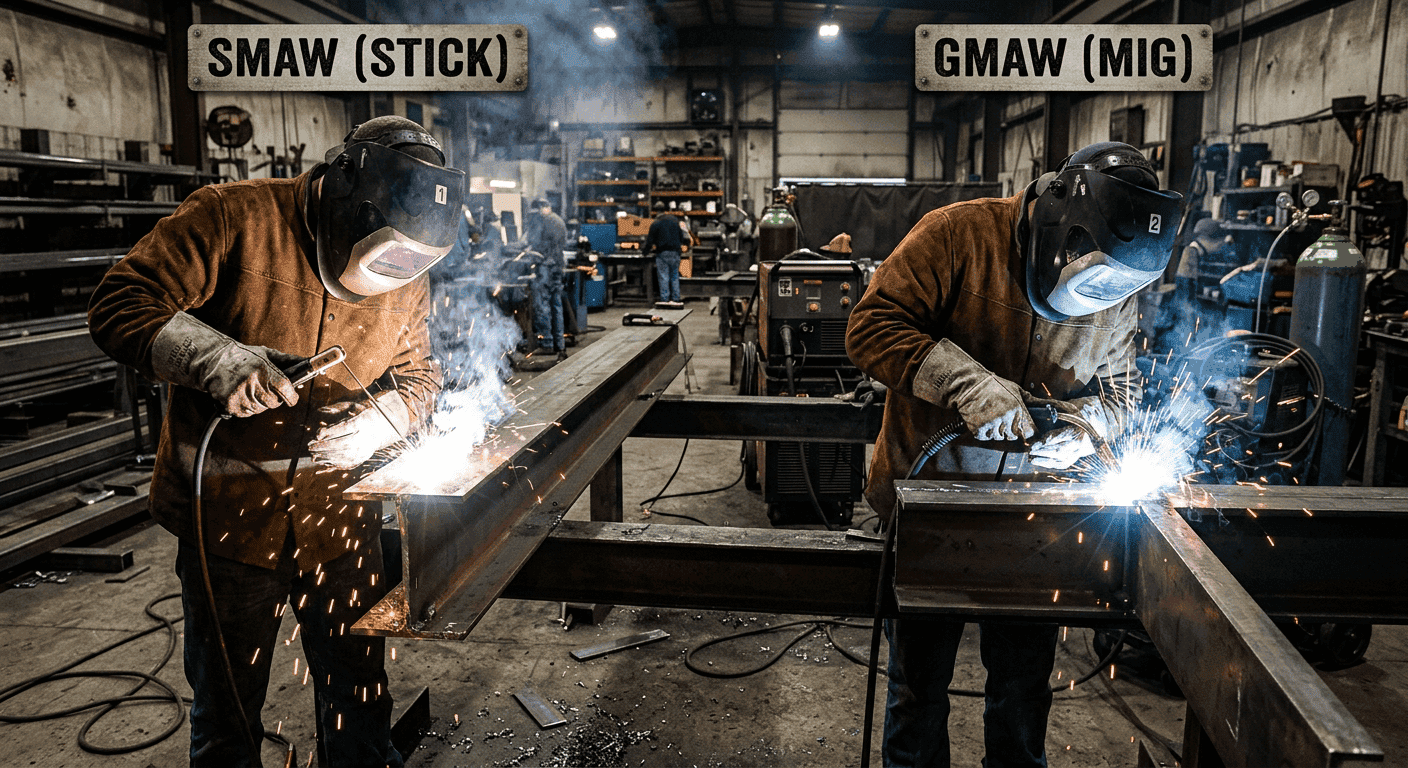
Shielded Metal Arc Welding, commonly known as stick welding, is a manual arc welding process that uses a consumable electrode covered in a flux coating to lay the weld. The welder strikes an electric arc between the electrode and the base metal, melting both to form the weld pool. The flux coating shields and protects the molten metal from atmospheric contamination, producing slag that protects the weld as it cools. SMAW is a versatile welding technique, favored for its simplicity and portability, making it ideal for field repairs and maintenance work.
What is Gas Metal Arc Welding (GMAW)?
Gas Metal Arc Welding (GMAW), commonly referred to as MIG welding (also known as Metal Inert Gas), employs a continuous wire electrode fed through a welding gun and an inert shielding gas to protect the weld pool from atmospheric contamination. It is considered to be the easiest to learn, as it is easy to control the speed of the wire, allowing you to make long welds without stopping to replace a rod. This process is suitable for a wide range of metals, including welding aluminum, steel, and stainless steel. GMAW allows for faster welding speeds and cleaner welds compared to SMAW, making it an efficient choice for production environments. The continuous wire feed and shielding gas contribute to its higher efficiency in various welding applications.
What are the Key Differences Between SMAW and GMAW?
SMAW and GMAW differ significantly in their equipment setup, welding technique, and use cases. Each method has distinct advantages depending on the application, environment, and types of materials. Understanding these key differences, characteristics, and applications is essential for choosing the appropriate welding process to ensure optimal weld quality and efficiency. Factors such as the type of metal, the required weld quality, and the welding environment play critical roles in determining whether SMAW or GMAW is the more suitable option.
Welding Technique and Equipment
SMAW, or stick welding, uses a consumable electrode coated in flux to create an electric arc that melts the base metal and filler material to form a weld in the joint. The welder manually feeds the electrode, requiring a higher level of skill to maintain consistent arc length control. In GMAW, the wire electrode feeds automatically into the spool gun, allowing for continuous welding. This automated feed system makes GMAW easier to learn and operate, resulting in more consistent weld quality and reducing welding time.
Metal and Gas Usage
SMAW is mainly suitable for homogenous welding, where the base metal and filler metal are similar. The flux coating on the SMAW electrodes provides the necessary shielding, eliminating the need for separate shielding gas. In contrast, GMAW relies on an external shielding gas supply, such as argon or a mixture of argon and carbon dioxide, for weld protection. GMAW is suitable for both homogenous and heterogeneous welding, offering greater flexibility in joining dissimilar metals. The use of shielding gas in GMAW prevents atmospheric contamination of the weld pool, resulting in cleaner and stronger welds.
Weld Quality and Speed
GMAW offers better efficiency thanks to its ability to lay down cleaner welds with minimal spatter and slag. This reduces the need for post-weld cleaning and finishing, saving time and labor. Regarding weld quality, both SMAW and GMAW deliver exceptional results when performed correctly. However, GMAW generally produces more consistent and visually appealing welds due to its continuous wire feed and shielding gas protection. When comparing the speed between GMAW vs. SMAW, the former takes the lead because of its higher deposition rates and continuous operation.
Cost Considerations
GMAW tends to carry a somewhat higher overall cost than SMAW, primarily due to the more complex equipment and the need for shielding gas. SMAW requires a more affordable initial investment since the equipment needed is relatively simple compared to the more complex setup required by GMAW. However, the higher productivity and reduced post-weld cleaning associated with GMAW can offset the initial cost in high-volume production environments. Evaluating the long-term costs, including labor, materials, and efficiency, is crucial when deciding between SMAW and GMAW.
GMAW and SMAW Quick Comparison
To quickly showcase the key distinctions, the following table is helpful for professionals needing a concise overview of SMAW versus GMAW before making a decision.
| Factors | SMAW | GMAW |
|---|---|---|
| Equipment Cost | Low | Moderate to High |
| Portability | High | Low to Moderate |
| Welding Speed | Low | High |
| Metals Welded | Primarily Ferrous Metals | Wide range (Steel, Aluminum, Stainless Steel) |
| Material thickness | Thicker materials (>3mm) | Thin to medium thickness |
| Indoor / Outdoor | Both — excellent outdoors | Primarily indoor; wind disrupts shielding gas |
| Operator Skill | High Skill Required | Moderate Skill Required |
| Slag Formation | Yes | Minimal |
| Shielding Gas | No Shielding Gas Needed | Requires External Shielding Gas |
| Weld Quality | Dependent on Operator Skill | Generally Consistent |
| Code compliance | Widely accepted across AWS, ASME, API | Also widely accepted; verify per code |
Advantages and Disadvantages of SMAW
SMAW, or shielded metal arc welding, presents clear advantages in certain scenarios. Its capability to effectively weld on various ferrous metals positions it as a versatile option for many projects. The minimal equipment needed enhances its portability, making it well-suited for remote locations where complex setups are impractical. However, SMAW is not without its drawbacks. Slag inclusions can occur if interpass cleaning is neglected, potentially affecting weld quality and increasing the need for post-processing. Additionally, SMAW is intermittent due to the need to periodically replace the consumable electrode, which can impact welding time.
Advantages and Disadvantages of GMAW
GMAW, or gas metal arc welding, offers numerous advantages, including faster welding speeds compared to other welding processes. It is capable of welding a wide range of metals, including steel, aluminum, and stainless steel, providing excellent weld appearance and soundness, and it minimizes slag and spatter formation, which reduces post-weld cleanup. Its adaptability to semi-automated or fully automated welding systems enhances its efficiency for production environments. One notable disadvantage is its limited portability compared to SMAW. Moreover, GMAW’s sensitivity to drafts or outdoor conditions that can disrupt the shielding gas can complicate weld quality in less controlled environments.
Which is Better? Choosing the Right Welding Process
Choosing between SMAW and GMAW depends on the specific project requirements. If portability and cost-effectiveness are paramount, and if the project involves primarily ferrous metals, SMAW might be the better choice. On the other hand, if speed, weld quality, and the ability to weld a variety of metals are critical, GMAW should be considered. (PS: For projects requiring high levels of precision, a welder may favor GTAW welding, or gas tungsten arc welding) When using GMAW, remember that this welding method relies on a shielding gas to protect from atmospheric contamination, which can be costly. A skilled welder considers material thickness and desired weld pool characteristics, making their choice carefully.
However, regardless of process, any welding performed on structural, pressure-containing, or safety-critical components should be:
- Performed to a qualified Welding Procedure Specification (WPS) that has been tested and documented in a Procedure Qualification Record (PQR)
- Executed by welders qualified under the applicable code (AWS, ASME, API, etc.)
- Tested by an independent, accredited laboratory to verify weld integrity and code compliance
What this means for your welding project or QA requirements is that the choice between the two processes — SMAW or GMAW — will dictate how the weld is made. But the qualification and testing requirements dictate whether it meets your project’s standards. Both elements matter equally.
How WH Labs Can Support Your Welding Projects
Once you’ve determined the right process for your project, you need a welding partner you can trust to execute it — on spec, on time, and to code. WH Labs has been providing certified welding services in Houston, TX for over 40 years, working directly on client projects across oil & gas, petrochemical, chemical processing, power generation, marine, and more. Reach out to our team to discuss your requirements and get a free quote.
SMAW and GMAW Welding Applications in the Industry
SMAW welding applications are found in the construction, shipbuilding, and pipeline welding industries, favored for its versatility and cost-effectiveness in on-site repairs and structural welding. In contrast, GMAW has found favor in automotive manufacturing, aerospace fabrication, and general metal fabrication industries. GMAW is often used where precision and clean welds are required. The choice between these two types of welding, SMAW or GMAW, depends heavily on the specific needs and constraints of your project.
Conclusion
Understanding these distinctions allows procurement managers and welders to decide which process suits their needs and project requirements. In the world of welding, SMAW and GMAW both serve essential roles and uses.
FAQs
Is SMAW Stronger Than GMAW?
The strength of a weld depends more on the technique of the welder and the quality of the filler metal used rather than the welding process itself. When comparing SMAW and GMAW, both can produce high-strength welds if performed correctly. The quality of the weld is significantly influenced by the electrode, shielding gas, and the welder’s proficiency, making the choice of welding technique a crucial factor. With GMAW welding, the welding parameters provide strong welds, but the technique is still important.
Does GMAW Equipment Cost More Than SMAW Equipment?
GMAW equipment typically involves a higher initial investment compared to SMAW due to the need for a wire electrode feeding system and shielding gas cylinders. GMAW offers an automated wire feed and more complex power supplies, increasing GMAW equipment cost. SMAW equipment, consisting mainly of a power source and SMAW electrodes, is more affordable. However, the reduced cleanup and faster welding time associated with GMAW can balance costs in the long run. The key differences in setup and electrode type directly affect the upfront expenses.
Is SMAW Easier To Use Than GMAW?
In general, SMAW, or stick welding, is often considered more challenging to master compared to GMAW. GMAW, or MIG welding, is more forgiving because of its continuous wire electrode feed. While SMAW is more challenging because it requires greater manual dexterity to maintain a consistent arc length, it can be quicker to set up for small jobs. GMAW’s ease of use makes it accessible to welders with less experience, but because of equipment costs and complexity, it’s not necessarily simpler to start with.