Expert Metallurgical Testing Spring Valley Village, TX
Our ISO 9001 & ISO/IEC 17025-accredited independent lab near Spring Valley Village, TX offers comprehensive metallurgical testing services, including microstructure analysis, material identification, and mechanical properties testing. With our state-of-the-art equipment and expert team, we deliver accurate and reliable results to meet your specific requirements.
Metallurgical Testing Techniques We Use
Metallurgical testing may sound complex, but while there are multiple methods involved, each serves an important purpose in ensuring the quality and reliability of metals and alloys.
Optical Microscopy
Optical microscopy allows for magnifying and analyzing the microstructure of metals and alloys. Examining samples under a microscope enables us to assess grain size, shape, and distribution, along with identifying any potential defects or irregularities within the material.
Scanning Electron Microscopy (SEM)
On a more detailed level, scanning electron microscopy (SEM) provides high-resolution imaging of materials, allowing us to visualize surface morphology and gain insights into elemental composition and bonding characteristics. This technique is particularly valuable for examining fracture surfaces and identifying failure origins within a material.
Energy-Dispersive X-ray Spectroscopy (EDS)
In conjunction with SEM, energy-dispersive X-ray spectroscopy (EDS) offers elemental analysis, revealing the composition of a sample with exceptional precision. This data is essential for understanding the chemical makeup of metals and identifying impurities or alloying elements present in a material.
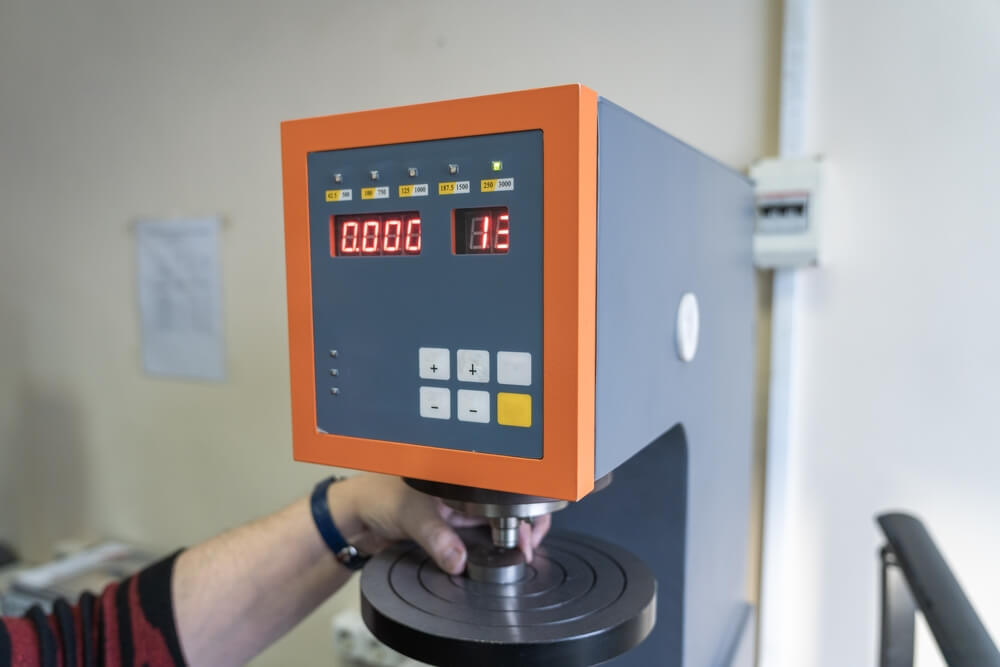
Hardness Testing
When it comes to determining the resistance of a material to deformation, hardness testing is indispensable. Different methods, such as Rockwell, Vickers, and Brinell tests, provide valuable insights into the strength and durability of metals, guiding material selection for specific applications based on hardness requirements.
Tensile Testing
Tensile testing involves subjecting a sample to controlled tension until it fractures. This valuable method enables us to quantify a material’s mechanical properties, such as ultimate tensile strength, yield strength, and elongation, painting a comprehensive picture of its behavior under load.
Impact Testing
Impact testing assesses how effectively a material can withstand sudden loads or shocks. By subjecting samples to controlled impact forces, we can evaluate their toughness and resilience to sudden failures, providing vital information for applications where impact resistance is critical.
Corrosion Testing
Corrosion testing is essential for evaluating a material’s susceptibility to degradation when exposed to corrosive environments. Whether simulating real-world conditions or accelerated corrosion tests, this technique ensures that materials maintain their integrity and performance over time in corrosive settings.
Each of these techniques plays a vital role in our pursuit of ensuring the reliability and performance of metals and alloys across diverse applications. Through meticulous examination and analysis using these methods, we can make informed decisions regarding material selection, quality control, failure analysis, and process improvement initiatives.
Spring Valley Village Metallography & Heat Treatment Assessments
WH Labs provides metallographic analysis and heat treatment assessments for manufacturers and engineers in Spring Valley Village and the surrounding Houston area.
Metallographic Analysis
We examine your metal samples at the microstructural level to evaluate grain size, phase distribution, elemental composition, and internal defects. These findings directly indicate how a material will perform under load, temperature, or stress, and whether it meets specification before it goes into service.
Heat Treatment Assessments
We verify that heating and cooling processes have produced the intended changes in your material’s properties, whether that’s increased hardness, improved ductility, or stress relief. If a treatment hasn’t performed as expected, we identify where the process deviated and what it means for the component.
These services are commonly required in aerospace, automotive, oil and gas, and construction applications where material behavior must be predictable and documented.
Mechanical Testing
Mechanical tests delve deeper into the physical properties of a material. Tensile testing helps us understand how much stress a material can endure before breaking, while impact testing reveals how well it withstands sudden shocks. Meanwhile, fatigue testing helps gauge its endurance over extended periods of stress, and fracture toughness testing provides insights into its resistance to cracking when exposed to flaws or cracks. Together, these tests provide a well-rounded understanding of how a material behaves in real-world scenarios.
Non-Destructive Testing (NDT) Methods
Our non-destructive testing methods serve as the detective work of materials analysis. Techniques such as ultrasonic testing, radiography, and magnetic particle inspection allow us to peer into materials without altering or damaging them. This inspection encompasses detecting internal imperfections, verifying structural integrity, and identifying potential weaknesses that could compromise performance.
Diving into these details provides a multidimensional understanding of materials behavior. From their composition to their mechanical properties and even internal structures, our comprehensive suite of tests leaves no stone unturned in ensuring a thorough assessment.
In essence, each of these tests plays a crucial role in evaluating how a material will function under specific conditions. It not only helps us identify any potential weaknesses but also ensures that the materials meet the necessary standards for their intended use.
Lab Equipment in Use
Our Spring Valley Village metallurgical testing lab utilizes advanced equipment to evaluate material composition, structural integrity, mechanical properties, and performance.
- Optical Microscopes – Used to examine grain structure, inclusions, cracks, and other microscopic material characteristics.
- SEM-EDS Systems – Provide high-resolution imaging and elemental analysis to identify surface features and chemical composition.
- Hardness Testers – Measure material hardness using Rockwell, Brinell, and Vickers testing methods.
- Tensile Testing Machines – Evaluate strength, ductility, and overall mechanical performance under load.
- Impact Testers – Assess toughness and fracture resistance under sudden force or stress.
- Corrosion Testing Chambers – Simulate harsh environments to evaluate corrosion resistance and long-term durability.
- Non-Destructive Testing (NDT) Equipment – Detect internal flaws and discontinuities without damaging the material.
This equipment allows our team to deliver accurate metallurgical analysis and dependable testing results across a wide range of industries and applications.
Benefits of Employing Metallurgical Lab Services
Using metallurgical lab services isn’t just about testing materials; it’s about ensuring the integrity, quality, and performance of materials. When you create a product, it’s not just about the design on paper. It’s about using the best materials to ensure it holds up out there in the real world. That’s where our metallurgical lab comes in.
Without proper testing, a material can look perfect on the outside but have hidden defects deep within. This kind of flaw might be undetectable until a product is in use, causing it to fail unexpectedly. Our lab, however, enables the identification of material defects before they have a chance to compromise product performance or safety. We conduct microscopic analyses and other advanced testing procedures that allow us to see right into the heart of a material and spot any irregularities that might affect its behavior under different conditions.
For instance, aluminum alloys are commonly used in aerospace applications due to their high strength-to-weight ratio. In such critical uses, it’s imperative to verify the material composition with absolute certainty and ascertain that it meets all relevant specifications. Our metallurgical lab conducts thorough tests to verify the material composition, leaving no room for doubt and ensuring utmost reliability and safety in high-stakes applications like these.
Incorporating metallurgical lab services into manufacturing processes doesn’t just optimize product quality. It ensures reliability and safety by proactively identifying material defects, assessing material behavior under stress, and verifying material composition.
Areas We Serve
WH Labs is equipped with the latest technology equipment and certified technicians to conduct metallurgical tests near Spring Valley Village, TX, and all surrounding areas. Call us at 713-895-7504 for your questions or get a free quote here.
- Harris County
- Jersey Village
- Aldine, TX
- Houston
- South Houston
- Bellaire
- Houston Heights
- La Porte
- Pasadena
- West University Place
- Jacinto City
- Bayport Industrial District